seepage · 6 min read
Winter wall dampness: condensation or a leak?
Compare winter dampness, cold surfaces and leak timing in your Delhi NCR flat. Know what to record safely and when a source investigation is needed.
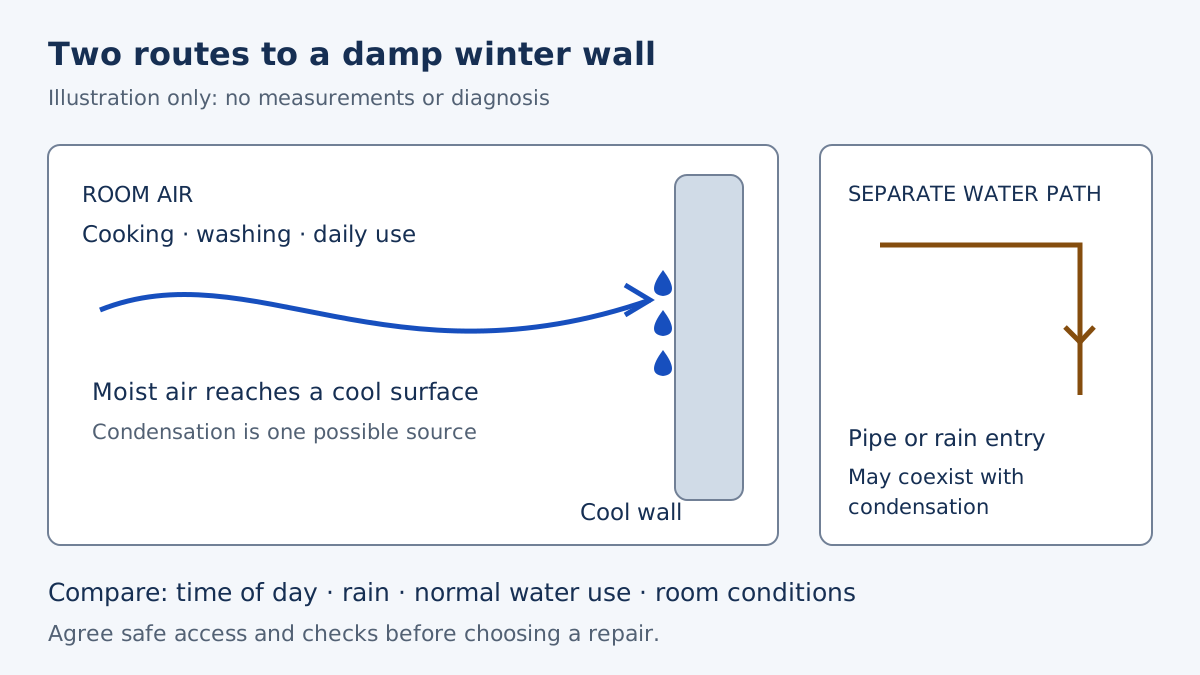
Winter wall dampness can come from condensation, a leak, or both. Moisture on colder surfaces during cold weather may be condensation. A patch that changes with rain or water use also needs a leak investigation. The season, the stain and a single humidity reading cannot settle the cause in a Delhi NCR flat.

Why do corners and windows become damp in winter?
Condensation is water forming when moist air meets a surface cold enough for that moisture to condense. A corner, window surround or wall behind furniture can behave differently from the centre of the room. The UK government's damp guidance identifies these colder locations. The explanation of how moisture behaves is useful here; the English housing rules are not Indian requirements.
Cooking and washing also add moisture to indoor air. The UK home ventilation guide explains the contribution of cooking, washing and showering, when moisture cannot leave the home. That alone does not show that a resident caused a building defect. Ventilation, heating, insulation and water entry can all need attention.
In your flat, note whether you keep the bedroom closed overnight and whether nearby wet-area extractors work. Compare the damp in the morning and afternoon. Share these observations at the visit; they do not establish that the damp is normal winter behaviour.
Which observations help separate condensation from leakage?
Compare timing and location before choosing a repair. Use the table to discuss possible checks with the inspector. It cannot diagnose the cause, and your room may fit more than one row.
| What you notice | What to discuss with the inspector | What it does not establish |
|---|---|---|
| Droplets on glass and several cool corners in the morning | Indoor moisture, surface temperatures and ventilation | That concealed plumbing is sound |
| One patch changes after use of a nearby bathroom | Water-use history and accessible supply or waste routes | Which pipe, joint or wet-area layer is responsible |
| Damp around an external opening changes after rain | Window perimeter, wall entry paths and weather exposure | That every visible crack is a water path |
| Damp remains behind a fixed wardrobe | Restricted access, local surface conditions and hidden damage | Whether the wall is dry behind the joinery |
| Different areas respond to different conditions | More than one moisture source | A single repair covering the whole room |
The WBDG moisture-management guide distinguishes water entry from indoor moisture and condensation. Much of this design guide concerns overseas commercial buildings. It supports checking several possible causes; it does not provide a wall construction specification for an NCR apartment.
What can you record safely before a visit?
Make a short observation record while arranging help. If the patch keeps growing, seek help without waiting weeks to collect evidence.
- Photograph the whole wall and a closer view from the same positions, with the date recorded separately.
- Mark the location on a simple room sketch. Include nearby bathrooms, windows and fixed furniture.
- Note when you first see moisture, whether it disappears, and whether rain or ordinary water use preceded a change.
- Record any recent window replacement, repainting, plumbing work or new cabinetry.
- If you already use a room humidity monitor, note its location and reading alongside the time. Do not label the wall dry from that number.
- List inaccessible areas and who can authorise access to them.
Do not remove sockets, scrape suspect growth, dismantle cabinetry or open shared shafts for this exercise. If water reaches electrical fittings, keep away and seek qualified help. You can help the investigation by recording what you see.
Will opening windows solve the dampness?
It may help manage indoor moisture, but it cannot repair a leaking pipe or a rainwater entry path. The EPA moisture guide includes ventilation and reducing indoor moisture among condensation-control measures. Their usefulness depends on the room and its surroundings.
In Delhi NCR, a blanket instruction to leave every window open is impractical. Discuss an appropriate ventilation approach where outdoor conditions, security, noise or building restrictions limit window use. Use existing extractors according to their instructions. If they seem ineffective, ask for an assessment; do not modify shared ventilation ducts yourself.
A humid room alone is not a reason to buy an interior coating. Ask what evidence supports the proposed cause, what improvement to expect, and how the contractor will check it. A contractor should explain whether the proposal concerns room conditions, building fabric, plumbing, or more than one of these.
What should a useful assessment clarify?
Ask for the observed moisture pattern, possible sources, checks completed and access limits. Ask the assessor to explain thermal patterns or moisture-meter readings alongside other evidence. Neither proves the source on its own.
For an apartment, the source may require access beyond your room. Arrange society permission for shared areas and coordinate with an adjacent or upstairs owner through the proper channel. If you cannot arrange access, ask the assessor to record what remains unresolved. An inaccessible area cannot be treated as clear.
A repair decision should follow the evidence. For a persistent wall seepage concern, keep the area accessible until you agree the cause and follow-up with the contractor. Do this before a wardrobe or fresh wall finish covers the area.
What do homeowners commonly ask?
Can condensation and a leak occur together?
Yes. The UK damp guidance recognises that several causes can contribute. Improving ventilation may reduce droplets while a separate leak continues to wet the wall. Record which symptom improved and which did not.
Does a dry afternoon prove the problem has stopped?
No. It only shows what you saw that afternoon. Share the morning pattern too, and ask whether further checks under relevant conditions are needed.
Is winter dampness the same as seepage?
Not necessarily. Our guide to seepage, leakage and dampness explains the terms. Dampness is the symptom; condensation and water entry are different possible causes.
If the pattern is recurring or the cause remains unclear, discuss leakage and seepage assessment with your observation record and access details. Agree the investigation scope before arranging another surface repair.
Related reading
- Damp wall near an AC: drain leak or condensation?
- Moisture meter readings on walls: how to read them
Sources and further reading
- UK government: existing home ventilation guide: indoor moisture and winter ventilation; England-specific regulatory sections do not apply here.
- UK government: understanding damp and mould: cold-surface patterns and multiple causes; cited for mechanisms, not legal or medical advice.
- WBDG: moisture management: building-envelope and indoor-moisture mechanisms, with climate-specific design limitations.
- US EPA: moisture in the home: general condensation-control guidance, not a diagnosis or service guarantee.