seepage · 7 min read
Damp wall near an AC: drain leak or condensation?
A damp wall near your AC may involve drainage, pipe condensation or a building leak. Learn what to record safely and which professional to contact.
A damp wall near your air conditioner may result from escaping condensate, condensation on a cold pipe or surface, or an unrelated building leak. If it changes with AC use, start by arranging an AC technician's assessment. If it follows rain or nearby plumbing use too, include a separate building-leak investigation rather than assuming the AC explains everything.
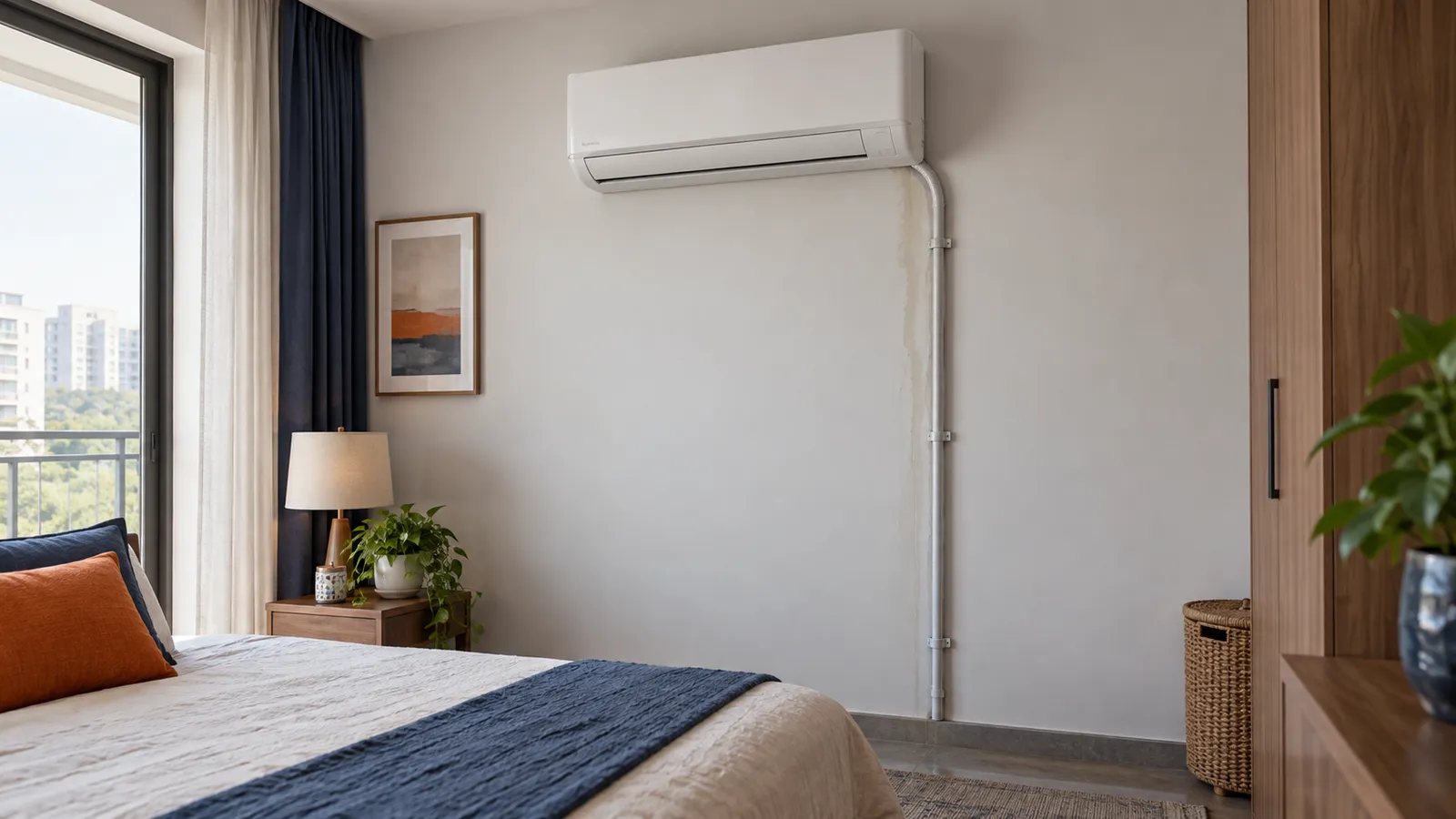
Where does an AC get water from?
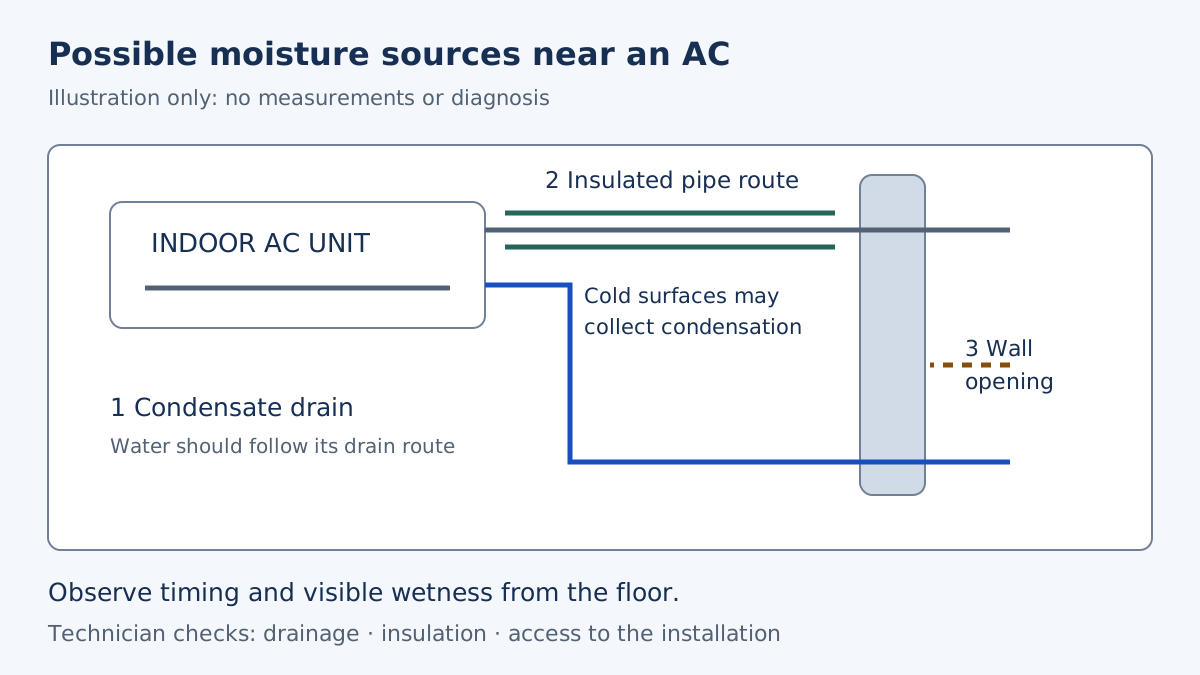
During cooling, moisture from indoor air can collect as condensate and needs a route out. An AC with a working drain carries water out; water escaping into the room needs investigation. Daikin's troubleshooting guidance distinguishes indoor leakage from expected condensation at parts of an outdoor unit and identifies drainage obstructions or bends as possible faults.
A damp wall does not tell you which part failed. It might be wet below the indoor unit, beside the route through the wall, or farther along a concealed drain. Tell the technician where you see water so they can choose what to inspect. Location alone does not justify opening the wall.
Tell the technician whether the problem began after installation, servicing, relocation or interior work. If someone boxed in the pipe route after installation, share any installation photographs you have. Do not remove the box to collect evidence.
How are a drain leak and pipe condensation different?
With a drain fault, water escapes instead of travelling through the condensate drain. With pipe condensation, moisture forms where moist air meets a cold surface. The technician needs to check these causes in different ways, even if the stains look similar.
| Possible path | Helpful observation | Professional check to discuss |
|---|---|---|
| Condensate fails to drain as intended | Wetness appears during cooling or near a known drain route | Drain condition, connections and installation arrangement |
| Cold pipe or nearby surface collects moisture | Visible droplets near a cold route during operation | Continuity and suitability of insulation, with room conditions |
| Water enters at a wall penetration | Dampness changes after rain | Weather sealing and the building entry path |
| Another concealed water source is involved | The patch also grows without AC use | Nearby plumbing and adjoining wet areas |
The EPA guide identifies insulation of cold pipes as a condensation-control measure. Ask the technician to check the insulation. Do not wrap an unidentified wet pipe yourself: the material and installation details must suit the installation and follow the unit manufacturer's requirements.
What should you do when water is actively dripping?
Stop using a leaking indoor unit and arrange service. Daikin advises against continued operation when an indoor unit leaks because the leak can damage surrounding finishes and furnishings. Keep away from wet electrical fittings. Ask a qualified person to make the area safe if needed.
Do not remove the casing, pour liquids into the unit, force air through a drain or try to access a high outdoor outlet. Do not keep running the AC to reproduce a leak for a video. Start by sharing a photograph you can take from a safe position on the floor and the time you last used the AC as normal.
For a high-rise flat, an external hose or pipe route may be inaccessible without specialised access. Society maintenance and the installer should coordinate that access. Do not lean out of a window to inspect the route.
Which details make the first visit more useful?
Give the technician these details:
- The unit's make and model, if available from existing records.
- Whether the stain appeared before or after recent AC work.
- Where you first see water, as well as where it pools.
- Whether cooling was operating, and whether rain or nearby water use also occurred.
- The approximate pipe and drain route, only where already known.
- Any inaccessible sections, false ceilings, cabinets or shared drainage connections.
Keep rain and AC use in separate columns in your notes. If both happened on the same evening, say so. The technician needs to consider that overlap; it does not prove which caused the problem.
A short history can help the technician avoid checking only the indoor unit and overlooking the concealed route on another visit. Ask which sections they examined and which they could not reach.
Who should inspect first: AC technician or leak specialist?
Contact an AC technician first if you see leakage start at the unit or soon after cooling use. Ask them to assess the equipment and its condensate and insulation arrangements. Confirm the scope: an AC service package may not include concealed-drain investigation.
If the technician checks the unit but cannot establish the source, or the patch also follows rain or plumbing use, discuss water leakage detection. The WBDG guide explains why moisture problems involving outer walls and openings, and heating, ventilation or air-conditioning systems can interact. It does not establish which trade is responsible for a particular flat.
If you need both investigations, ask each person to record their findings for the next visit. If a technician concludes it is "not an AC problem", ask them to list the checks they performed. Our guide to when professional plumbing help is needed explains the boundary around concealed pipe work.
What evidence should come before repainting?
Ask the technician to record the fault they found, their repair and the follow-up check. A stopped drip is useful, but it does not establish that nearby wall material is ready for decoration. Preserve access to the repaired route until the agreed observation and drying steps are complete.
Before interior work starts, agree this sequence with the AC installer and finishing contractor. It is easier to discuss access while the route is visible than after new joinery covers it. Ask who will assess remaining dampness and who will decide that the chosen finish can be applied; do not assume those tasks are included in the AC invoice.
What else do homeowners ask?
Can a drain fault and insulation problem happen together?
Yes, they are separate possible mechanisms. Ask the technician to check both relevant routes. Finding one visible issue does not prove they have found all the sources.
Does water coming out of the drain rule out an AC fault?
No. Visible discharge alone does not verify the entire installation. Tell the technician what you saw; it is not a pass result.
Does Ezeetask's seepage assessment replace AC servicing?
Do not assume that it does. Discuss the symptom through leakage and seepage assessment, and confirm whether an AC technician or another specialist needs to attend separately.
Related reading
If you have a visible damp patch, the wall seepage guide helps you record the symptom before discussing investigation or repair.
Sources and further reading
- Daikin: air-conditioner troubleshooting: indoor leakage, drain-path faults and service referral; follow the manual for your model.
- US EPA: moisture in the home: cold-pipe insulation and condensate maintenance principles.
- WBDG: moisture management: the interaction between mechanical systems and building moisture, not a diagnosis of this installation.