seepage · 7 min read
How do you know a wall is dry after leak repair?
Check wall drying after leak repair with repeat evidence and the chosen finish’s requirements. Understand meter limits before scheduling new paint.
Before finishing a wall after leak repair, the contractor needs to address the source and assess the remaining moisture using a suitable method. The surface must also meet the preparation requirements for the chosen finish. A pale patch, a dry touch or a fixed number of days is not enough on its own. Agree how readiness will be checked before booking the painter.
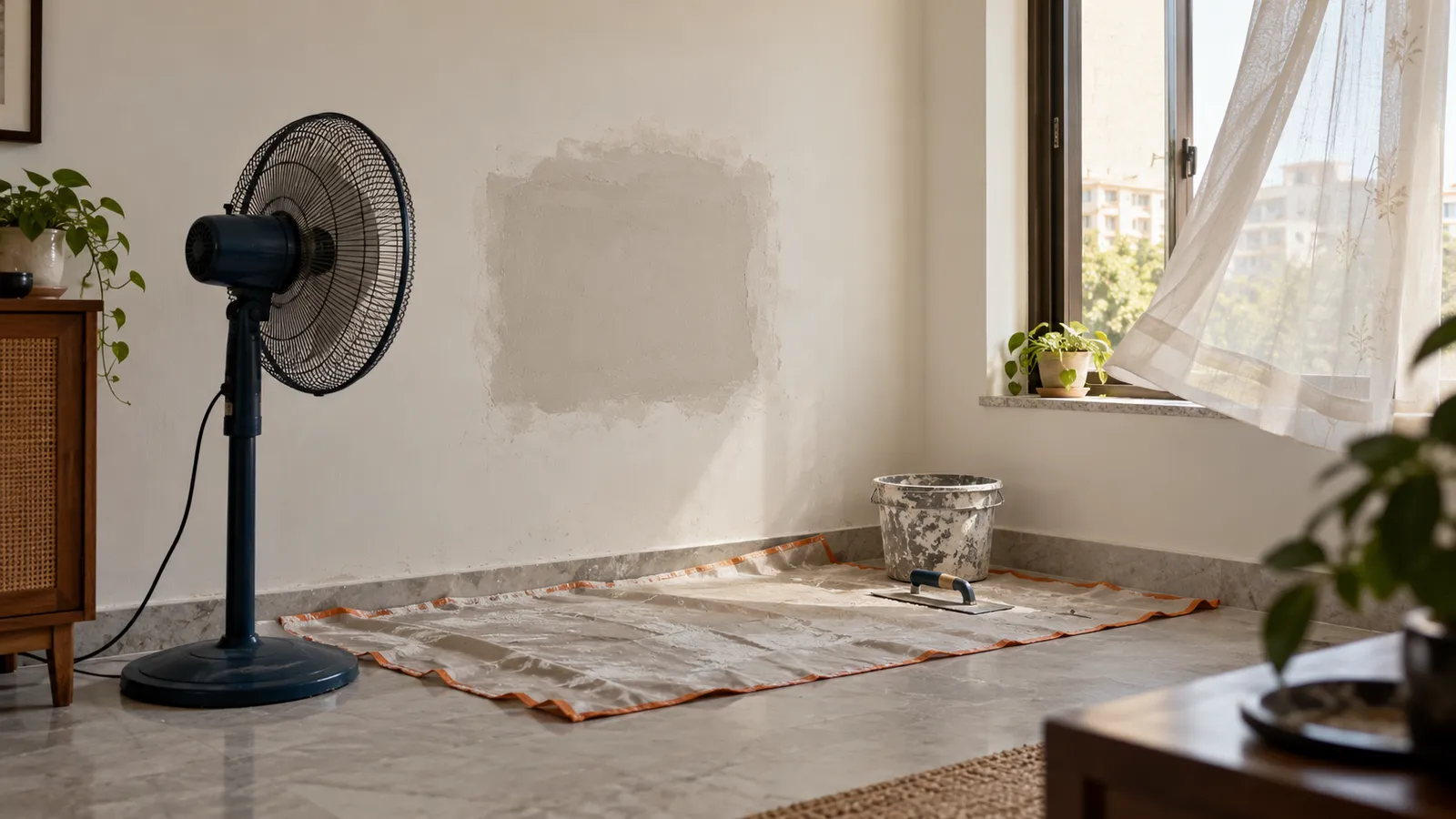
Why can the wall stay damp after a successful repair?
After a repair stops new water entering, the wall still needs to lose the water it holds. Wall material and surrounding layers can retain moisture after the repair. Whether that moisture can leave depends on the construction and drying conditions.
The WBDG moisture-management guide explains the importance of allowing accumulated moisture to drain or evaporate, and how finishes affect moisture movement. It does not provide a drying timetable for a repaired brick or plaster wall in your flat.
The contractor also needs evidence before calling continued dampness residual moisture. The repair may have missed another source. Ask what evidence distinguishes continued water entry from drying, especially if the affected area expands or responds again to the original trigger.
Does a dry surface mean the whole wall is dry?
No. Looking at the wall tells you about the surface alone. Different measurement methods examine different parts of a material, and an assessor may not be able to establish the condition of inaccessible layers. FLIR's moisture-meter guidance distinguishes pin and pinless measurements and warns that you cannot treat their readings as interchangeable.
Ask the assessor to record the location, material and instrument mode with each reading. Without those details, you may struggle to interpret the number later. Ask what the instrument can and cannot establish at that spot. A thermal image shows differences in surface temperature. It cannot certify dryness.
Do not buy a meter and use an online percentage as a universal painting threshold. Ask the assessor whether the reading measures what the finish specification requires. A relative scale does not necessarily measure moisture content by weight.
What should be recorded at repeat checks?
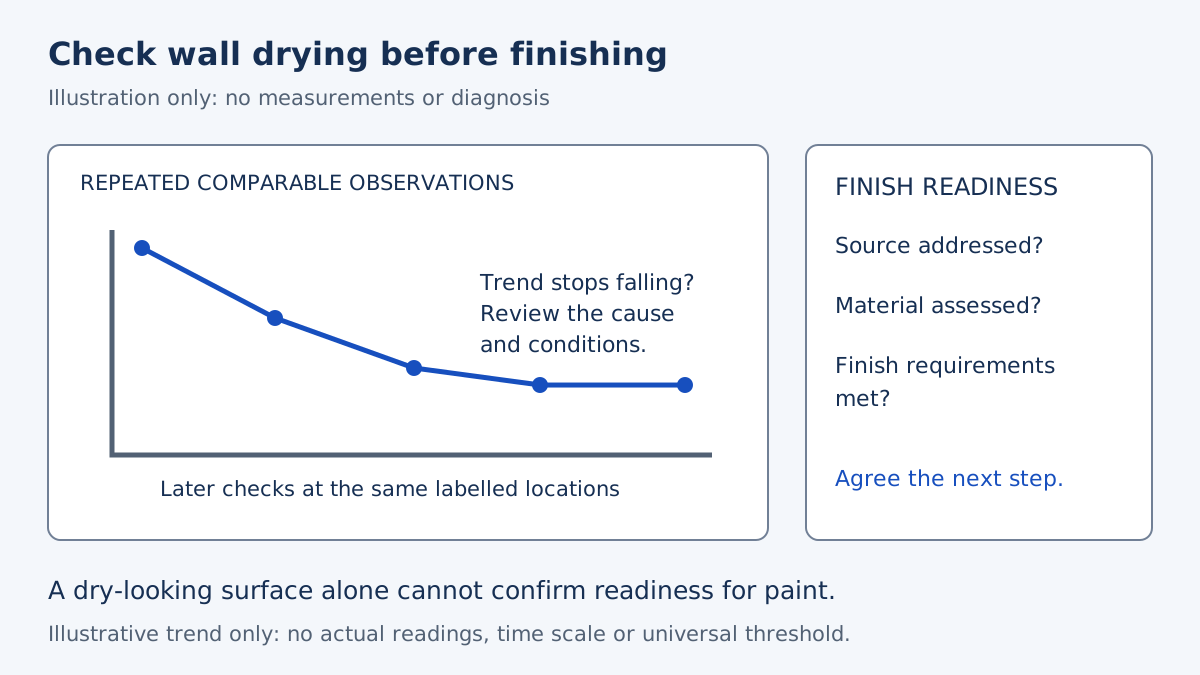
Agree a record with the person assessing the wall so you can compare like with like at repeat checks and decide the next step:
| Record | Why it helps |
|---|---|
| Repair location, completion date and work description | Shows which repair the drying checks follow |
| Labelled measurement positions | Avoids comparing different parts of the wall by mistake |
| Material, meter model and measurement mode | Helps the assessor interpret the number |
| A suitable comparison area where available | Gives context from comparable construction |
| Room conditions and recent rain or water use | Identifies changes that may affect interpretation |
| Visible changes and inaccessible layers | Keeps the limitations alongside the readings |
| Next check or finishing requirement | Helps you agree the next step |
FLIR describes comparison with material of known dryness and similar construction when using a pinless meter. The assessor must decide whether a neighbouring wall meets those conditions before using it as a reference. This guidance does not establish that Ezeetask uses a particular instrument at every visit. Confirm the proposed method and scope before booking.
What if readings fall slowly, stop changing or rise again?
Ask the assessor to explain the trend before agreeing to wait longer. A downward trend can support a drying assessment, but it does not by itself prove that the chosen coating can be applied. If readings stay level or rise, ask the assessor to review drying conditions, the comparison method and possible further water entry.
For a Delhi NCR apartment, record whether the original concern was linked to a neighbouring bathroom, a shared shaft or rain. A repair observed only during dry weather may leave a rain-related question unresolved. Record that unresolved question and agree how to check it. Do not perform a roof flood test or soak the external wall yourself.
Discuss drying arrangements with the contractor. Keep approved access available and follow the equipment instructions if the contractor uses professional drying equipment. Do not use exposed heating elements, improvised wiring or aggressive DIY heat against the wall to force a deadline.
Which requirements matter before primer, putty or paint?
Ask for the current technical data sheet for the exact product system proposed, including any substrate moisture and preparation conditions. Ask the painter what "dry" means for that product and surface. A generic internet rule cannot replace the product requirements.
For example, Jotun Interior Primer (C)'s published data sheet requires a sound, clean, dry substrate. It also gives coating drying and recoating times under stated conditions. Its coating times are not the time needed to dry a previously waterlogged wall. This is a product example from a dated sheet, not a recommendation to use that primer in your home; obtain the current local specification.
If mould or damaged material is present, address that before decorating. The EPA guide says not to paint over mouldy surfaces and to resolve the moisture problem. Stain-blocking paint does not prove that someone has resolved the underlying issue.
How should repair and decorating hand over to each other?
Use a brief written record between the repair team and the painter. Ask the repair team to describe their work and follow-up evidence, including any areas they could not access. Ask the painter to record the finishing requirements they will follow. Record who makes the finishing-readiness decision and whether another visit is needed.
If your interior work is on a tight schedule, agree this handover before work starts. Ask the joinery contractor to keep the affected wall accessible until the relevant checks are complete. Book the finishing work once the evidence supports it. A booking date does not make the wall dry.
For work being planned through seepage repair, discuss this handover before agreeing the scope. If the patch has already reappeared after decoration, see why damp returns after painting and revisit the source as well as the finish.
What are the common drying questions?
How many days should I wait?
There is no single reliable number for all walls. Ask for an assessment based on the material, extent of wetting, access, conditions and intended finish, with a review point instead of a guaranteed date.
Does a stain mean the wall is still wet?
Not necessarily. You can see a stain without knowing how much moisture remains. Ask for a moisture assessment; the absence of a stain does not prove the wall has no remaining moisture.
Can I compare readings from two different meters?
Not as if they were the same scale. Record the instruments and methods, and ask the assessor to explain whether a comparison is meaningful.
Related reading
If you have a visible damp patch, the wall seepage guide helps you record the symptom before discussing investigation or repair.
Sources and further reading
- WBDG: moisture management: drainage, evaporation and finish interactions; no universal drying duration.
- FLIR: wet and dry moisture-meter values: measurement modes and comparison limitations, not a coating acceptance standard.
- Jotun: Interior Primer (C) technical data sheet: a product-specific example separating substrate preparation from coating drying.
- US EPA: moisture in the home: resolve the water problem and address mould before painting.