seepage · 7 min read
How to check whether a seepage repair worked
Check seepage repair completion with original findings, recorded work, professional verification and later observations, beyond a fresh coat of paint.
To check whether a seepage repair worked, compare the original concern with the completed scope, appropriate professional verification and later observations under relevant conditions. Fresh paint cannot prove success, and residual dampness or an old stain alone cannot prove that the repaired source still leaks.
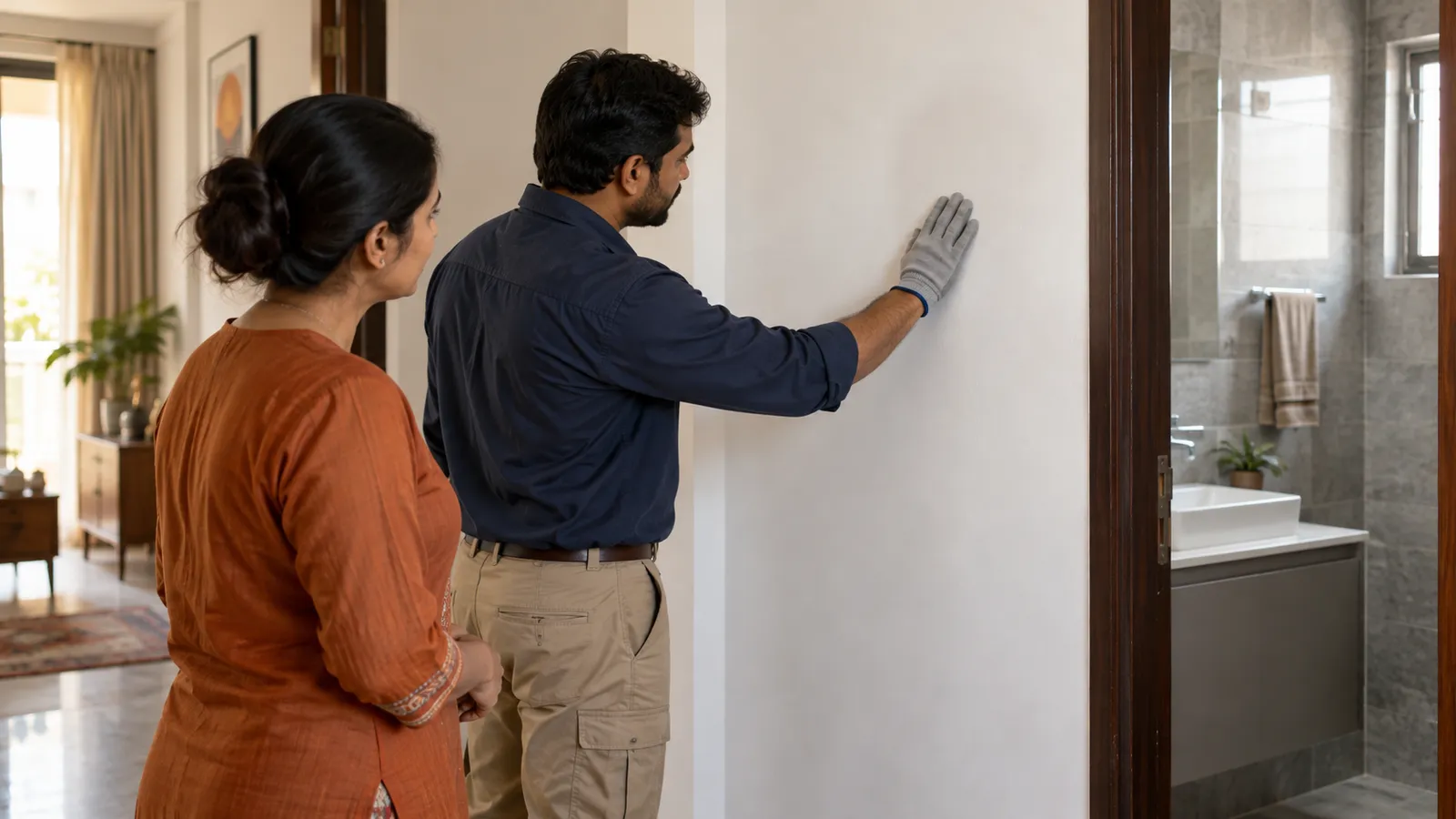
What should be recorded before work begins?
Agree what the contractor will repair. Is it stopping a documented pipe leak, addressing a particular rain-entry location or repairing a defined wet-area assembly? "Make the room dry" leaves too much undefined if several possible sources remain.
Keep the original photographs, the exact location, when the symptom appeared and the findings behind the agreed repair. Note any parts of the property that were inaccessible. The seepage inspection report overview shows the kind of location-linked evidence to discuss; the report records the inspector's findings. It does not prove that later repairs succeeded.
Agree which checks the professional will do before closing surfaces and what you can only observe later. Write down who will perform each check and how the result will be recorded. These decisions are easier to make before tiles, plaster or cabinetry cover the relevant area.
How is repair completion different from drying and finishing?
Ask whether the contractor has carried out the agreed work, whether the available checks support its intended performance and whether the affected material is ready for restoration. A single "completed" message may leave two of these questions unanswered.
EPA's homeowner guidance separates correcting the water problem from drying and cleanup, and advises against painting mouldy surfaces. It does not supply a universal wall-drying time. Ask the professional responsible for restoration how they will check that the material is ready for the planned finish.
Avoid setting your own deadline from a generic online answer. Record why the contractor has left a finish incomplete: drying, curing, access or an unresolved concern. If a contractor recommends waiting, ask what observation or requirement will end the wait and who will communicate that decision.
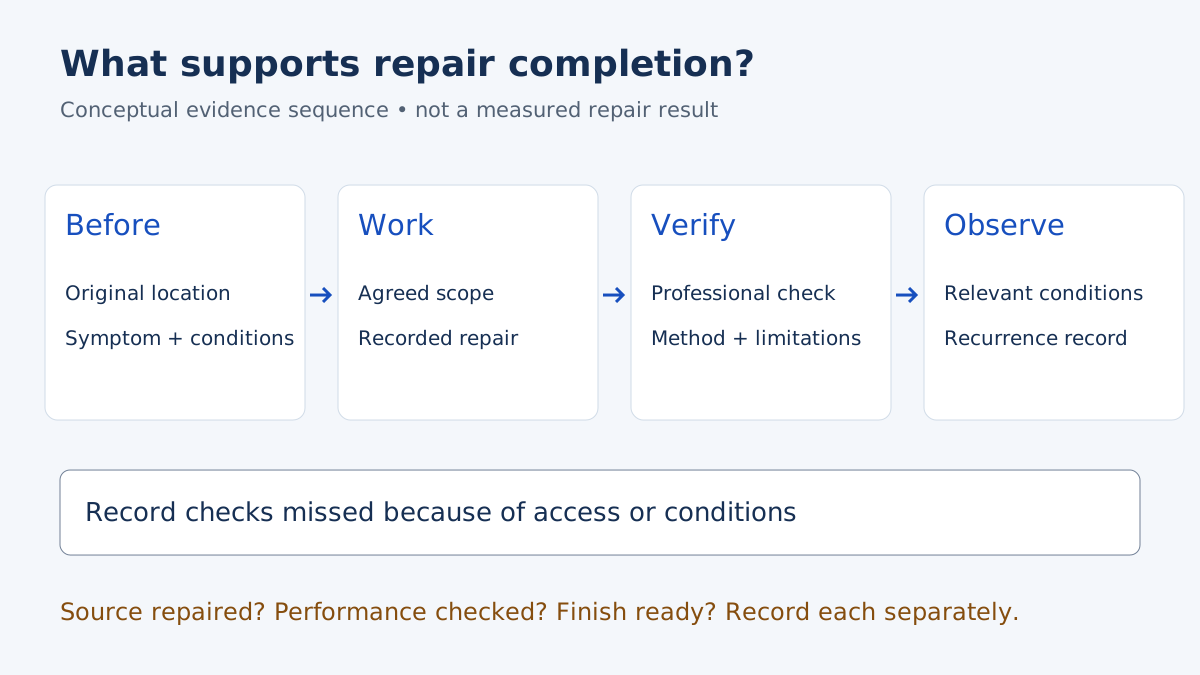
Which evidence should the completion record contain?
Ask the contractor to connect the recorded work to the original concern. Unrelated close-up photographs make this difficult.
| Evidence | What it should tell you | What it cannot establish alone |
|---|---|---|
| Original location and finding | What the repair set out to address | That every possible source was found |
| Work-stage photographs | Where and what work was recorded | Correct hidden construction in every area |
| Professional test record | Method, conditions and observed result | Performance outside the tested scope |
| Readings, where appropriate | Location, method and comparison context | A universal pass/fail threshold |
| Finish status | What has been restored or is unfinished | Whether an unseen source has stopped |
| Follow-up observations | Whether the concern recurs in use | A guarantee against every future leak |
EPA's building guidance includes verification tests and checklists across moisture-control work. Ask the professional to document a method that suits the repair. The guidance is not a local inspection certificate or a prescribed test for your property.
Can a water test or thermal image prove success?
A suitable professional test can add evidence, but its scope and conditions need to be stated. For example, Schluter describes water testing as a quality-control check on its shower installation before tiling, with system-specific waiting requirements. The method depends on the assembly and installation stage. It does not give owners a procedure for flooding an existing bathroom.
Leave water containment, pressure testing and any access at height to qualified professionals following the applicable system requirements and permissions. Ask what part of the system the check covers, what could not be checked and whether the professional observed the result in the area where the original symptom appeared.
Thermal images need similar care. FLIR explains that temperature differences can have causes other than moisture, and that conditions such as weather and indoor humidity affect interpretation. Ask what other evidence confirms the images and whether they show comparable locations. Two pictures with different colours are not enough to judge success.
How should seasonal and apartment conditions be handled?
A contractor may be unable to reproduce a rain-related concern in Delhi NCR on a dry completion day. Record the weather limitation and agree how the professional will review later observations. Do not label the rain-dependent question verified because there was no active symptom during the visit.
For a concern associated with the flat above, arrange authorised access if verification requires it. If the upstairs wet area could not be used or inspected, record that gap. Record unavailable access as an unchecked area. Do not ask neighbours to perform improvised flooding or pressure checks.
For everyday observation, take photographs from a consistent safe position and note ordinary use and weather. Keep the record factual: a patch grew, stayed the same or was no longer visible. Avoid changing several conditions to "stress test" the repair. Share concerning changes with the responsible professional.
What if the stain remains or a new patch appears?
Ask for reassessment before assuming either success or failure. A remaining mark, continuing drying and renewed water entry are different possibilities. The professional should explain what evidence distinguishes them and whether any further access or check is needed.
Record a new location separately while preserving its relationship to the original concern. The professional can then follow the record if the new symptom comes from another source. Avoid repainting over a changing patch before it has been documented; a new finish can remove useful visible context without resolving the question.
If water is close to electrical fittings or material appears unstable, keep away from the affected area and seek appropriate professional help. Do not touch fittings or remove ceiling material to collect evidence. Safe observation is enough for the owner's record.
What are the common completion questions?
Is one dry photograph enough?
No. It records appearance at that moment. Ask for the repair record and the verification conditions, especially when the original concern was intermittent or rain-related.
Must every repair be tested in the same way?
No. The method must suit the source, assembly, installed materials and access. Ask the professional to explain the selected check and its limitations instead of demanding an unsuitable test.
When should I raise a concern again?
Report renewed dripping, an expanding patch or another relevant change promptly, with dated observations. Ask what follow-up is appropriate rather than waiting for the mark to become severe.
To discuss seepage repair completion, bring the original report, agreed scope and completion evidence together. Ask the professional to record the status of each unresolved item before finishing work covers the area.
Related reading
If you have a visible damp patch, the wall seepage guide helps you record the symptom before discussing investigation or repair.
Sources and further reading
- EPA: moisture and the home: distinguishes water correction, drying and cleanup.
- EPA: building moisture-control guidance: verification framework, not Indian code certification.
- Schluter: shower-system water testing: manufacturer-specific professional context, not DIY instructions.
- FLIR: thermal imaging and moisture: why images need corroborating evidence.