seepage · 7 min read
How to read a seepage inspection report
Learn to separate observations, suspected causes and untested areas in a seepage inspection report before using its findings to agree a repair scope.
When you read a seepage inspection report, check what the inspector saw, what they tested and which explanations they still need to verify. A photograph of a stain records the symptom, but it cannot prove where water entered. Before approving repairs, check the evidence for the proposed work and look for any gaps in access or testing.
Where should you start reading?
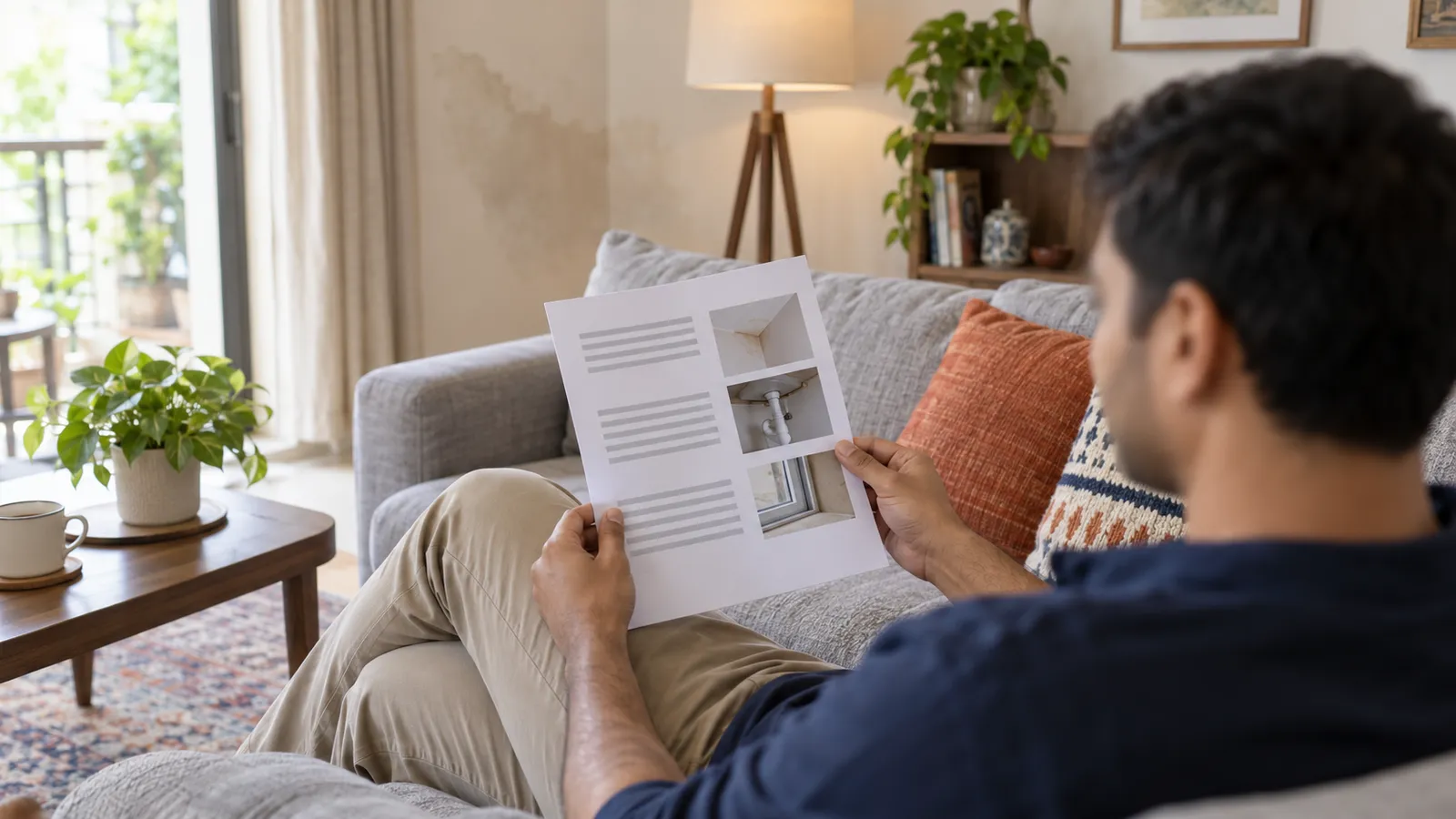
Start with what the inspection covered and what the inspector could not check. Then read the findings for each location. Note the inspection date, the rooms and surfaces they could reach, and relevant conditions that day. During a dry visit, the inspector can answer different questions from those they can check while water is dripping.
Check that the inspector recorded your concern as you described it. "Bedroom wall discolouration" may need a room name and wall orientation to distinguish it from another patch. If the report uses photographs, you should be able to match each one to a location without guessing from furniture alone.
The seepage inspection report page is a useful starting point for understanding the deliverable. Sample findings show how an inspector can organise observations. They cannot establish the cause at your property or prove that a recommended repair worked elsewhere.
What does each part of a finding mean?
Use this checklist to follow how the inspector reached a recommendation. Providers may use different headings for this information.
| Part of the finding | Question it should answer |
|---|---|
| Location | Exactly where was the concern observed? |
| Observation | What was visibly present at the visit? |
| Evidence | Which image, reading or completed check supports it? |
| Interpretation | What does the inspector think explains it? |
| Confidence or limitation | What remains uncertain or inaccessible? |
| Recommended action | What should happen next, and why? |
If the recommendation says "waterproof bathroom" but the evidence only shows a bedroom stain, ask the inspector how they connected the two. You need to understand the reason for the expense without expecting certainty that the checks cannot provide.
Is an observation the same as a confirmed cause?
No. "Paint is blistering" describes a condition. "Moisture may be entering from an adjacent wet area" is an interpretation. "A particular joint leaked during the recorded check" describes stronger evidence about that joint, but the report still needs to state the check's extent and conditions.
Thermal pictures require the same care. FLIR's guidance explains that temperature patterns can suggest moisture and require confirmation. The inspector should not describe a coloured region as a confirmed pipe failure in the summary without further evidence.
Look for clear wording such as observed, reported by owner, suspected, tested or not verified. Avoid reading those terms as interchangeable. If the inspector expresses uncertainty in the details but writes a certain conclusion, ask them to explain the difference before a contractor prices the work.
What would a useful finding look like?
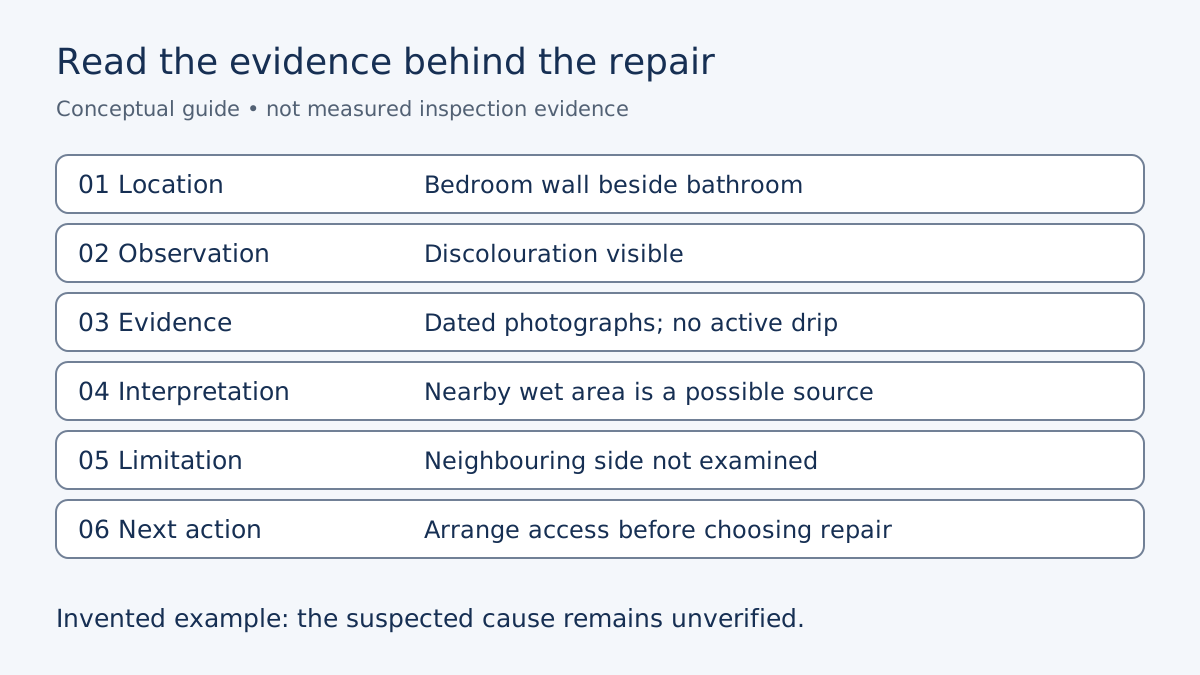
Consider this invented example, written only to explain the categories:
- Location: bedroom wall beside the shared bathroom.
- Observation: discolouration and peeling finish visible near the skirting.
- Evidence: dated overview and close-up photographs; no active water flow observed.
- Interpretation: adjacent wet-area involvement is one possibility, not established from appearance alone.
- Limitation: concealed construction and the neighbouring side were not examined.
- Action: obtain appropriate access and agree a targeted investigation before selecting a repair.
The example gives you the known observations and the information still needed before choosing a repair. It does not prescribe a coating or use invented readings, customer details or claims about repair performance.
In a Delhi NCR apartment, the access request may involve a neighbour or building maintenance. Use the report's observations to explain the access request. The report alone does not assign legal responsibility to a resident or the association.
Which limitations deserve follow-up?
Look for areas the inspector did not enter, surfaces hidden by cabinets or ceilings, unavailable utilities and checks they did not perform. "Not inspected" cannot be read as "satisfactory". Ask which of these gaps could change the recommended repair and which are unrelated to the current concern.
The ASHI Standard of Practice provides a useful professional reference: it calls for inspectors to identify designated items they did not inspect, give reasons and recommend further evaluation where appropriate. It is not an Indian statutory rule and does not define your purchased package.
A visual inspection also does not certify structural safety or code compliance. If your concern needs a professional from another field, ask whom you should consult and why. Do not infer an engineering clearance from the absence of a structural comment in a seepage report.
How should the report inform a repair quote?
Ask the contractor to reference the relevant finding and identify the area, preparation, materials, access and exclusions in the proposed work. Separate investigation still needed from repair already justified. An estimate that hides both under one broad line is hard to compare with another proposal.
Ask the contractor to specify work to remove and restore finishes, which may be separate from fixing the source. Agree how they will check completion and what evidence they will give you. For a recurring water problem, keep more than a photograph of the new paint as your completion record.
The EPA homeowner guide emphasises correcting the moisture problem and drying surfaces before painting mold-affected areas. Ask why the surface is ready for decoration at that stage. A new finish alone does not resolve the cause. Our inspection before waterproofing article explains the decision sequence.
What should you retain after repairs?
Keep the original report, agreed scope, repair date, location-labelled photographs and any follow-up record together. Preserve the original finding instead of replacing it with an undated "done" message. If the problem returns, you and the contractor can refer to the work you agreed and completed.
For each unresolved item, record the next action, who is arranging it and the access needed. You can keep this record yourself; it does not mean a particular report platform includes a tracking service. If the report leaves a question unanswered that could affect your decision, ask its author to clarify it in writing.
Frequently asked questions
Does every listed observation mean a defect?
No. Read the finding itself and its status. A report may also record satisfactory observations or limitations; a total count alone is not a damage score.
Can I send the report to a repair contractor?
Check the report's sharing and reliance terms first. Share only the relevant permitted information, with personal details protected.
What if I cannot understand the recommended repair?
Ask which finding supports it, what uncertainty remains and what outcome will be checked. For a new concern, discuss the evidence and scope through water leakage detection.
Related reading
If you have a visible damp patch, the wall seepage guide helps you record the symptom before discussing investigation or repair.
Sources and further reading
- ASHI Standard of Practice: reporting, further evaluation and inspection limitations.
- FLIR thermal leak guidance: interpreting thermal evidence.
- EPA homeowner moisture guide: source correction, drying and finish limitations.