seepage · 7 min read
Window frame leakage in rain: where to look
Rain around a window may involve its frame, drainage or wall joint. Learn what to record safely indoors and what to ask before adding more sealant.
If your window leaks during rain, record where you first see water: on the glass, in the track, at the joint between the frame and wall or on surrounding plaster. None of these observations alone proves where water entered. Stay inside and photograph the sequence. Ask a professional to assess the window's drainage and its connection to the wall before applying more sealant.
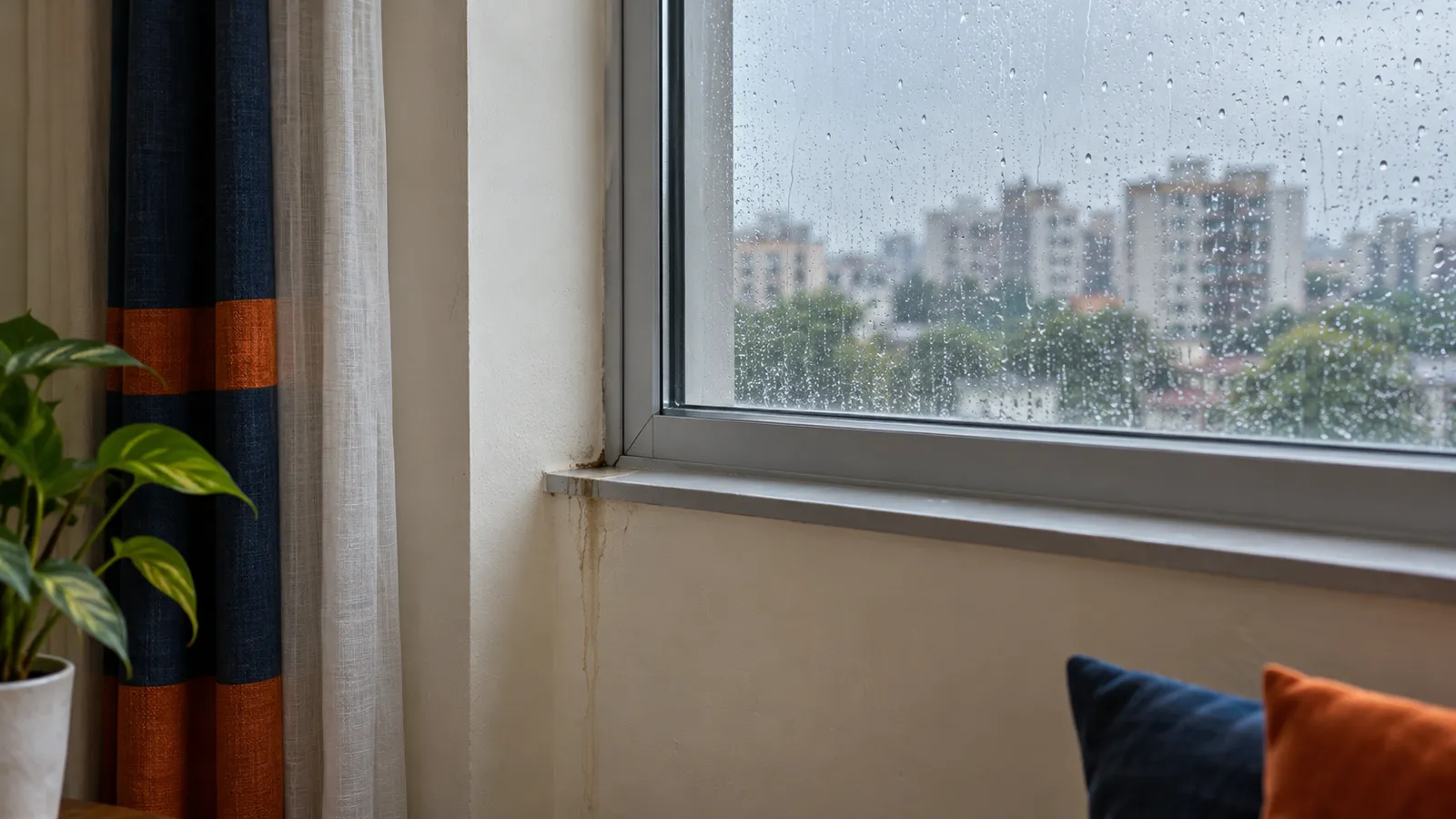
Is the water coming through the window or around it?
Note where you first saw water, even if another area became wetter after the storm. Tell the inspector whether it ran down the glass, rose in a track or appeared at the top corner of the plaster. By the time a sill is wet, the original path may be difficult to see.
The WBDG residential enclosure guidance describes window installation and flashing, which directs water away from joints, as part of the wall's moisture protection. Its construction details mainly concern North American housing. A contractor cannot copy them onto an NCR masonry opening without adapting them. The general principle is to inspect the connection between the window and wall as well as the window unit.
Write "water first noticed at the left frame corner" rather than "glass seal failed". Include which side is left when viewed from inside. The owner, maintenance manager and contractor then know which corner you mean when discussing the photograph.
What can you safely observe during rain?
Remain on the room side of a closed window. Do not lean outside, stand on a sill or remove a grille. If the floor becomes wet, keep people away from the slippery area. Move belongings only if you can reach them safely. Water near electrical fittings needs prompt attention from building maintenance and an appropriate professional.
Record the following without trying to reproduce the leak:
- The room and window, with a wide photograph showing the surrounding wall.
- Whether the window was closed and latched as intended.
- Where the first droplet, damp edge or overflow appeared.
- Whether water was confined to the track or crossed onto the room-side sill.
- The rain period and any wind direction you could observe, without inventing wind-speed measurements.
- Whether another window on the same side of the flat showed the same signs.
- Any previous sealant, frame replacement, painting or nearby exterior work.
If you notice the leak only after rain stops, record that limitation. Do not reconstruct the sequence from memory as if you watched it happen. A dry-weather photograph is still useful for showing staining and existing repair patches.
Which parts should the inspection distinguish?
| Area | Useful question | What an indoor photograph cannot settle |
|---|---|---|
| Opening sash and seals | Does the window close and latch normally? | Performance under the actual storm conditions |
| Lower track and drainage | Where is collected water intended to leave? | Condition of concealed drainage passages |
| Frame perimeter | Is water appearing at the frame-to-wall interface? | Continuity of hidden weather protection |
| Sill and surrounding wall | Are stains concentrated below or beside the opening? | Whether water travelled from elsewhere above |
| Nearby building details | Could a wall joint, balcony or other opening be involved? | Exterior condition beyond safe access |
In apartment buildings, the external wall may need society coordination even when the visible damage is inside one flat. Ask who can authorise access and what safe access method the contractor proposes. An inspector looking from the bedroom cannot verify exterior joints high up on the building that they cannot access.
Can adding sealant make drainage worse?
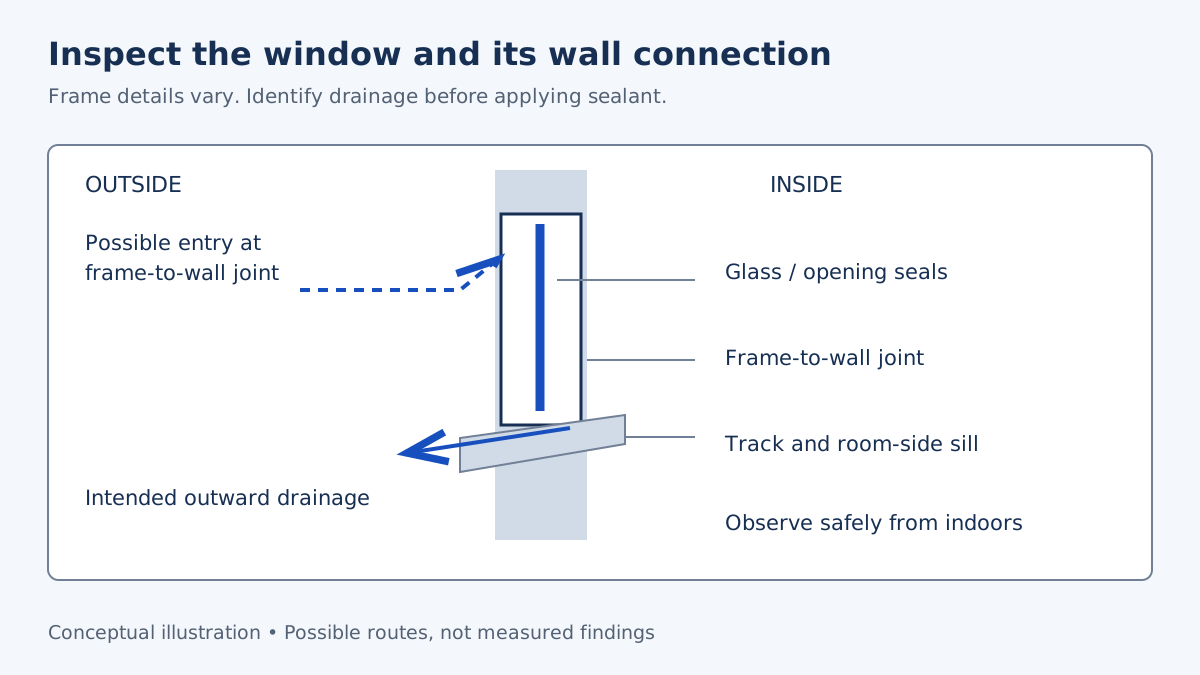
Sealant can make drainage worse if someone covers the openings that let water out. Some window systems collect water that gets into the frame and let it out through designed outlets. Andersen's care guidance explains this for its own products and notes that water may not drain immediately. The guidance applies to Andersen products. Other frames may have different drainage systems, and you should not treat water entering your room as acceptable.
Ask the installer to identify the window type and intended drainage route before sealing gaps. An opening may be a drainage feature rather than a defect. Do not drill new holes, push tools into passages or cover every slot with silicone based on a generic diagram.
Ask the contractor to specify which joint they will treat, what preparation they need and how they will keep the drainage working. "Seal all around" gives you too little detail to judge whether the work suits the frame. Clearing a track cannot prove that the contractor has repaired a leak around the wall opening.
What if the glass is wet but there is no obvious rain entry?
Condensation, where moisture in the air collects on a cooler surface, is another possibility. The WBDG moisture-management resource distinguishes rainwater intrusion from condensation associated with moist air and cooler surfaces. An exterior sealant repair may not address a problem caused by condensation.
Record whether droplets appear during dry weather as well, whether they are on the room-side glass and whether surrounding plaster also becomes wet. Discuss these observations with the inspector. You cannot use them as a reliable home test to rule rain entry in or out, and more than one condition may be present.
Do not rely on the colour of a stain or a single instrument reading to establish the cause. Ask the inspector to explain how the site pattern, weather history and any selected checks support their conclusion.
How should repair and follow-up be agreed?
Before work, ask for the proposed repair area, access arrangement and the evidence behind it. Keep the photographs from the original rain event. If a qualified professional proposes a controlled water test, they should specify and supervise it; do not use a pressure washer or a hose from an exposed balcony to imitate a storm.
After work, record what the contractor changed. Ask them to check the frame drainage, the joint they treated and the indoor finish as separate parts of the follow-up. A visit between storms cannot alone verify performance during rain. Agree how they will follow up on your installation and record anything they cannot resolve.
Avoid covering the surrounding wall with cabinetry or decorative panels while the route remains uncertain. You may find it harder to arrange access after interior work conceals the area. If the concern extends beyond the window, see the broader post-rain seepage checklist.
Questions before sealing a window
Does water in a sliding-window track mean the frame has failed?
Some systems manage water within the track, so water there does not prove the frame has failed. A professional should assess water crossing into the room, persistent pooling or wet surrounding finishes against the specific window design.
Can an internal bead of silicone solve an external leak?
The correct repair depends on the water path and how the window and surrounding wall were built. An internal bead may hide the visible exit without correcting where water entered. Ask for the reason behind the proposed location.
What should I send when seeking help?
Share the room, first visible water location, dated photographs and known exterior-access restrictions. For damp plaster around the opening, the wall seepage page provides context. Discuss a seepage and leak assessment when the route is uncertain.
Related reading
Sources and further reading
- WBDG: Residential Building Enclosure: window interfaces and moisture protection; construction-specific details require adaptation.
- Andersen: Product, Care and Maintenance Information, revised 2023: drainage and maintenance for Andersen products, not instructions for every window brand.
- WBDG: Moisture Management: general distinction between rain entry and condensation.