seepage · 7 min read
White powder on walls: efflorescence and moisture
White powder on walls may be efflorescence. Learn what salt deposits reveal, what they cannot prove, and what to record before cleaning or repainting.
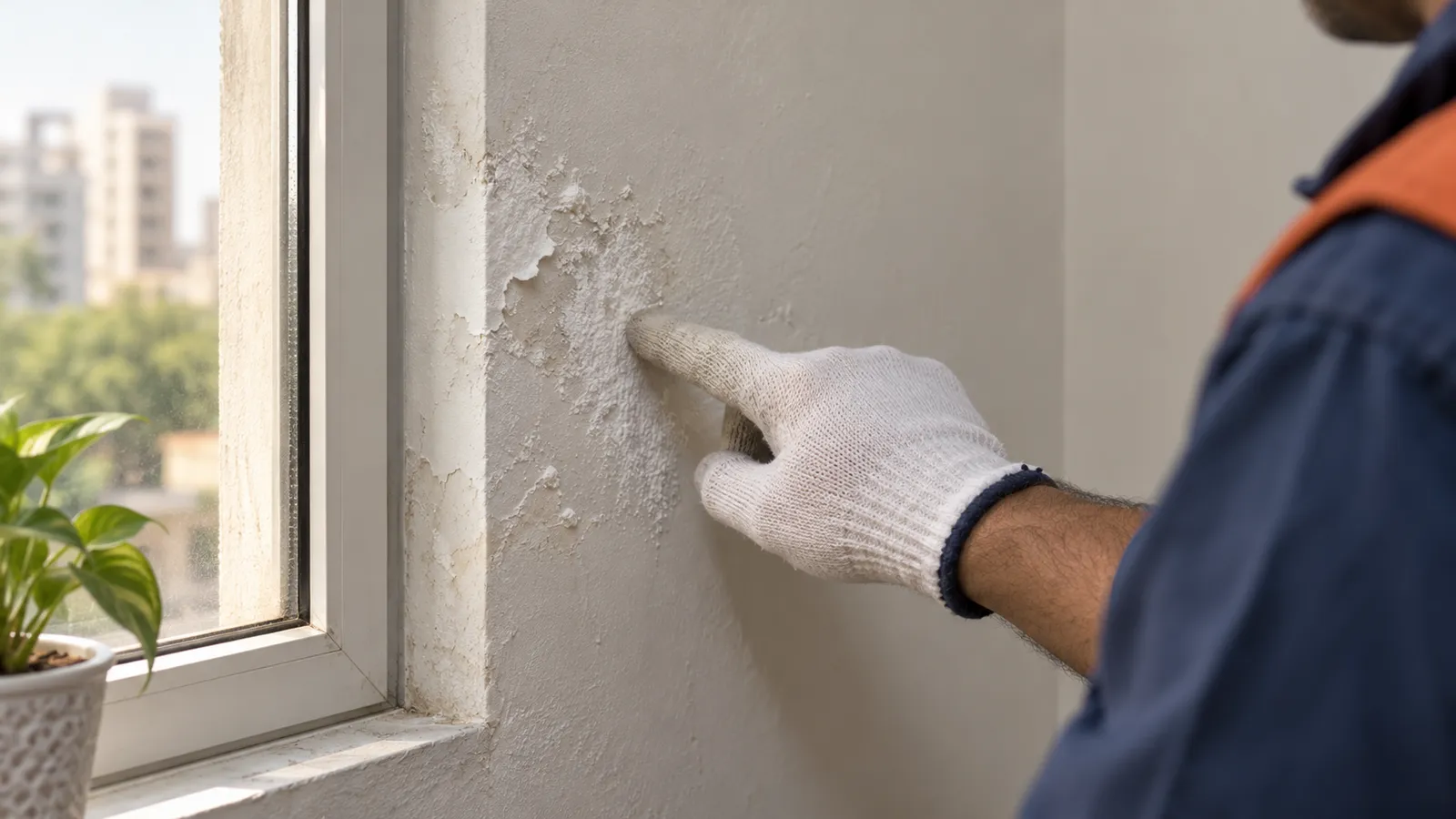
White powder on a wall may be efflorescence. These are salts left behind when water carrying dissolved minerals reaches a surface and evaporates. A photograph can help you record the deposit, but cannot confirm what it is or whether the original water source is still active. Note where it appears and whether it returns before choosing a cleaning or repainting treatment.
How does efflorescence form?
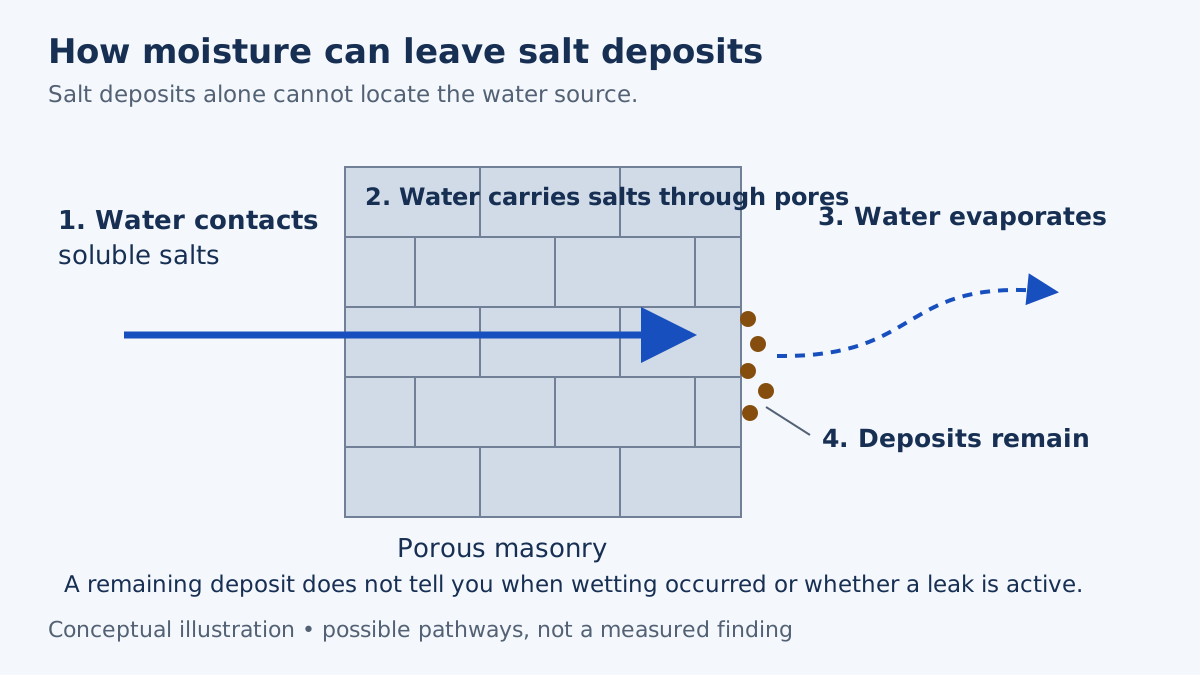
Efflorescence forms when water dissolves salts and carries them through or across a material to a surface where it can evaporate. Some salts remain there as deposits. The Brick Industry Association's Technical Note 23A explains these conditions and notes that salts can come from materials in contact with the visible brickwork, not just the brick itself.
If you find a white deposit, ask the inspector to investigate how it formed. The deposit alone cannot identify a leaking pipe, joint or outside surface.
Is every white deposit efflorescence or mould?
No. Loose coating material, construction residue and other surface deposits can look pale in a photograph. Colour alone is not a reliable identification method. Efflorescence is a mineral deposit; mould is biological growth. Use the terms for those different materials. Identifying what you can see does not establish what is on hidden surfaces.
Identification also matters when interpreting instruments. The RICS, Historic England and PCA guidance notes that salts can influence resistance-meter readings. The inspector needs to interpret the reading alongside other evidence before concluding there is a fresh leak. Do not taste an unfamiliar deposit, scrape it into the air or apply an improvised chemical mixture.
Describe what you can see: powdery or crusted, local or widespread, on paint or exposed masonry, with or without nearby peeling. If you cannot tell whether the material is a deposit or the wall finish breaking down, say so when arranging the inspection.
Does white powder mean water is leaking now?
The deposit may remain after the water that formed it has evaporated. WBDG explains this evaporation-and-deposit sequence. Salts alone cannot tell you when the wall became wet or prove that it is leaking now.
The Brick Industry Association also describes "new building bloom", which can form as construction moisture dries out of brickwork. An inspector still needs to establish the cause on a painted flat wall. The association's technical notes concern fired-clay brick; ask a contractor to check whether any construction or cleaning recommendation suits plaster, paint or other masonry products before using it.
For a newly handed-over Delhi NCR flat, record the deposit before interiors conceal the wall. For an occupied home, record earlier repairs and whether the visible deposit is new, unchanged or increasing. Keep dated photos in either case. They help you compare changes without assuming a contractor or neighbour caused the problem.
Which changes make investigation more useful?
Compare dated records to see whether the deposit is old and unchanged or whether the area is changing. Record what happens during normal use and weather; do not soak the wall to test it.
| Observation | What to tell the inspector | What not to conclude |
|---|---|---|
| Powder appeared after recent plaster or masonry work | Work dates and affected materials | That all new-build deposits are harmless |
| The same area changes after rain | Rain date, wall orientation and photographs | That a particular outside crack is the source |
| Deposits appear beside a bathroom wall | What is on each side of the wall | That the bathroom's waterproof layer has failed |
| Peeling and powder return after repainting | Previous repair and finishing sequence | That another primer alone will solve it |
| Deposits remain but the patch looks unchanged | Date of the last known wetting and current photos | That the hidden wall is dry throughout |
Take a whole-wall photo and a close-up, then repeat both from the same positions on later dates. Keep any original report and contractor scope with those images. Avoid writing on delicate finishes or removing the deposit just to create a before-and-after photograph.
Why is cleaning alone an incomplete response?
Cleaning changes the visible surface. Salts may appear again if water continues to carry them through the material. The Brick Industry Association recommends understanding and correcting the causes before removal, and advises against coatings as the sole efflorescence treatment for brickwork.
Ask contractors how they will address the cause when comparing their proposals. Choose a cleaning method that suits the deposit and the material beneath it; the brick guidance cannot supply a method for all walls. Acid cleaners, pressure washing and vigorous abrasion can be inappropriate for a painted internal wall. Ask a competent contractor to identify the material and propose a compatible method rather than following a brick-cleaning instruction on plaster.
If someone has refinished the wall, ask what they repaired before painting. Our guide to damp patches returning after painting explains why the surface work and moisture-source work need separate attention.
What should an assessment and follow-up record contain?
Ask the inspector to record the location, the material beneath the deposit, what they could see and any inspection limits. They should distinguish the deposit they observed from the moisture source they suspect, and explain what further checks they need to connect the two.
Before agreeing to work, ask:
- What supports the identification of this deposit?
- Is the moisture source established, suspected or not yet located?
- Which accessible areas were checked, and which were unavailable?
- Does the scope address water entry as well as the affected finish?
- How will the area be reviewed before decoration resumes?
- What should I record if the deposit returns?
In an apartment, source investigation may require another flat or a service shaft. Arrange access through the appropriate owner or facilities team. Ask the inspector to list any areas they could not access. A surface inspection also cannot certify structural condition or code compliance.
Common questions
Does efflorescence prove structural damage?
No. A deposit alone does not establish structural damage. If there is loose material, substantial cracking or deterioration, ask for appropriate professional assessment rather than drawing conclusions from the powder.
Can I paint as soon as the powder disappears?
Before painting, ask the contractor to establish what caused the deposit, whether anyone has addressed that source and whether the wall material is ready for the specified finish. The powder disappearing alone cannot answer those questions or set a drying deadline.
When should I arrange a seepage assessment?
Arrange one when deposits recur, spread or accompany unexplained dampness and finish damage. Use the wall-seepage page to describe the surrounding symptoms, then share the photographs and repair history with Ezeetask's leakage and seepage service. Agree what needs investigation before choosing paint.
Related reading
Sources and further reading
- Brick Industry Association: Efflorescence — Causes and Prevention: June 2019 technical note; fired-clay brick scope limits apply.
- WBDG: Moisture Management Concepts: salt movement, evaporation and material behaviour.
- RICS, Historic England and PCA: Investigation of moisture: September 2022 guidance on salts and measurement; traditional-building focus, not Indian construction rules.