seepage · 7 min read
Seepage warranties: questions to ask before repair
Understand seepage warranty questions: covered areas, inspection reassessment, repair remedies, exclusions and records to confirm before accepting work.
Seepage repair warranty coverage depends on the written service, treated area, covered failure and promised remedy. An inspection reassessment and corrective repair work cover different services. Before accepting a repair, ask for the terms attached to that job, including the start date, exclusions, reporting process and what costs the remedy includes.

Does an inspection warranty include repairs?
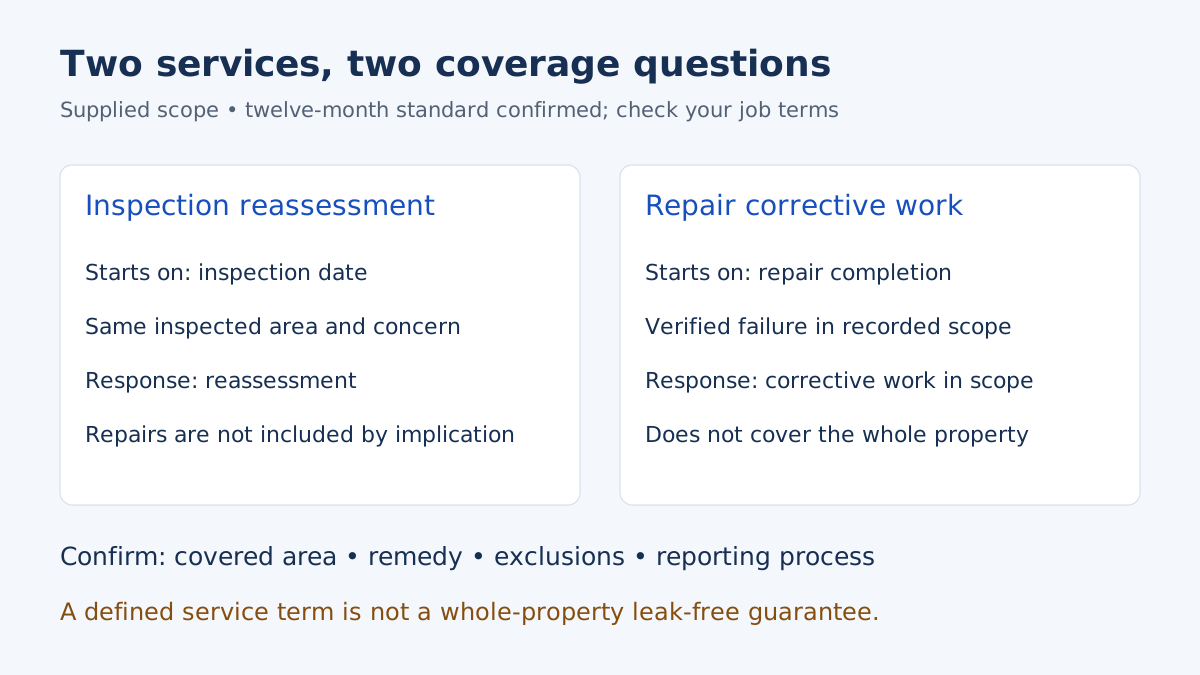
Ezeetask's warranty card covers two services separately. Inspection coverage means reassessment of the same inspected area and concern, with the term starting on the inspection date. Repair coverage means corrective work for a verified failure within the recorded repair scope, with the term starting on repair completion. A return assessment does not mean repairs are included.
Ezeetask's current standard term is twelve months. For inspection reassessment, the term starts on the inspection date; for corrective repair work, it starts on repair completion. The covered area, concern and work scope still matter. Obtain the written terms for your job rather than reading the duration as whole-property coverage.
Ask the provider what it promises if the concern returns: another assessment, remedial work or something else. Do not translate "we will revisit" into "all repairs are included".
How should the document describe the covered area?
Ask for enough detail to locate the work later. A room name alone may be ambiguous if the room has several external walls, pipe routes or wet-area boundaries. Ask the provider to mark the treated surface or joint on a photograph or sketch.
| Term to clarify | Useful question before acceptance |
|---|---|
| Covered service | Is this inspection reassessment or corrective repair? |
| Covered location | Which wall, joint, surface or assembly is recorded? |
| Covered concern | What recurring symptom or verified failure triggers review? |
| Remedy | What will the provider do after accepting the claim? |
| Start and end | Which recorded event starts the term? |
| Exclusions | Which causes or later changes fall outside the scope? |
| Associated costs | Are access, opening and finish restoration included? |
| Reporting process | Where, when and with which records should I report it? |
These questions do not establish Ezeetask exclusions. Ask the provider to answer each one in your agreement.
Why is a product warranty different from a repair promise?
A material manufacturer and an installer can offer separate documents for their responsibilities. Do not assume that buying a named product transfers its advertised coverage to every repair using it.
For example, Schluter's North American warranty summary makes coverage conditional on the applicable technical literature and installation requirements. Its exclusions guidance identifies unsuitable material selection and non-compliant installation among relevant conditions. These examples apply to that manufacturer. They do not establish terms for your Delhi NCR property or show that Ezeetask uses the system.
Ask who issues each document, which installed system it covers and who handles a concern involving both product and workmanship. Keep any manufacturer document alongside the contractor's scope. If a salesperson refers to a product warranty, request the version that applies to your installation. A screenshot of an advertising badge is not enough.
Which exclusions need a practical explanation?
Ask how the agreement treats a new source, work outside the treated area, later alterations and inability to access the repair location. Do not accept a verbal explanation that contradicts the written scope; ask the provider to resolve the difference before work starts.
Consider a hypothetical ceiling repair beneath another flat. If a separate pipe later leaks nearby, the visible symptom may resemble the original concern. The question is whether investigation connects it to the covered work. The provider should not accept or reject the claim on location alone.
Ask about access in an apartment. Who arranges entry to the upstairs flat or a society-managed shaft? What happens if access is delayed? A promise to attend your room may not provide access to the source. Write down who needs to arrange access before a concern returns.
If future interior work will cover the area, ask what records and access arrangements to preserve. Do not interpret this question as permission to open a wall or ceiling yourself. Agree any investigation that requires opening a surface with an appropriate professional, who should carry it out.
What evidence helps when reporting recurrence?
Keep the accepted quotation, scope, inspection findings, completion record and warranty together. When a concern returns, note the date, exact location and ordinary conditions: recent rain, bathroom use or another relevant change. Take a wider photograph and a closer image from safe floor level. Avoid editing the images in ways that obscure the condition.
Describe the observation without declaring its cause: "the same ceiling corner darkened again after rain" is more useful than "the membrane failed". Ask the provider to explain how it will assess whether the concern is within scope, and retain the written outcome.
A thermal image may assist investigation, but FLIR's guidance explains why a temperature pattern is not proof of moisture on its own. The provider needs other evidence and the written scope to assess coverage, whether or not a new coloured patch appears in the image.
What should I ask about duration and follow-up?
Request the exact start date, any reporting deadline and the procedure for acknowledging a complaint. Ask whether a return visit is included, when a separate charge may arise, and how you will be told before chargeable work begins. Do not infer a response time that the agreement does not state.
If the provider carries out corrective work, ask it to record what changed and whether the warranty end date changes. Keep that response rather than assuming either that the clock restarts or that it cannot restart. The applicable written terms must answer the question.
What are the common warranty misunderstandings?
Does coverage mean the whole property will stay leak-free?
A warranty for a recorded repair does not establish that unrelated parts of the property are covered. Ask which areas the warranty covers. The warranty card does not promise a leak-free property.
Can a repair be guaranteed without opening anything?
The necessary access depends on the source and construction. Read when seepage repair may require opening a surface, then ask how that applies to the proposed scope.
Does a recurrence automatically prove failed workmanship?
No. Report it promptly under the applicable process and ask for reassessment. A similar visible symptom can require further investigation before the provider can establish responsibility.
Before agreeing to seepage repair, ask for the scope and warranty together. Check what the provider will do for your recorded repair, as well as how long the warranty lasts.
Related reading
If you have a visible damp patch, the wall seepage guide helps you record the symptom before discussing investigation or repair.
Sources and further reading
- Schluter: warranty programme summary: illustrates conditional product/system coverage; North American example only.
- Schluter: conditions that void its warranty: illustrates why installation and material conditions need reading.
- FLIR: interpreting thermal moisture indications: evidence limits during reassessment.
Ezeetask's current warranty card is the source for the inspection-versus-repair distinction and the twelve-month term above.