home inspection · 7 min read
Re-inspection after builder repairs: what to verify
Check builder repairs against the original snag list, record what remains unverified, and agree the scope and charges before booking a follow-up visit.
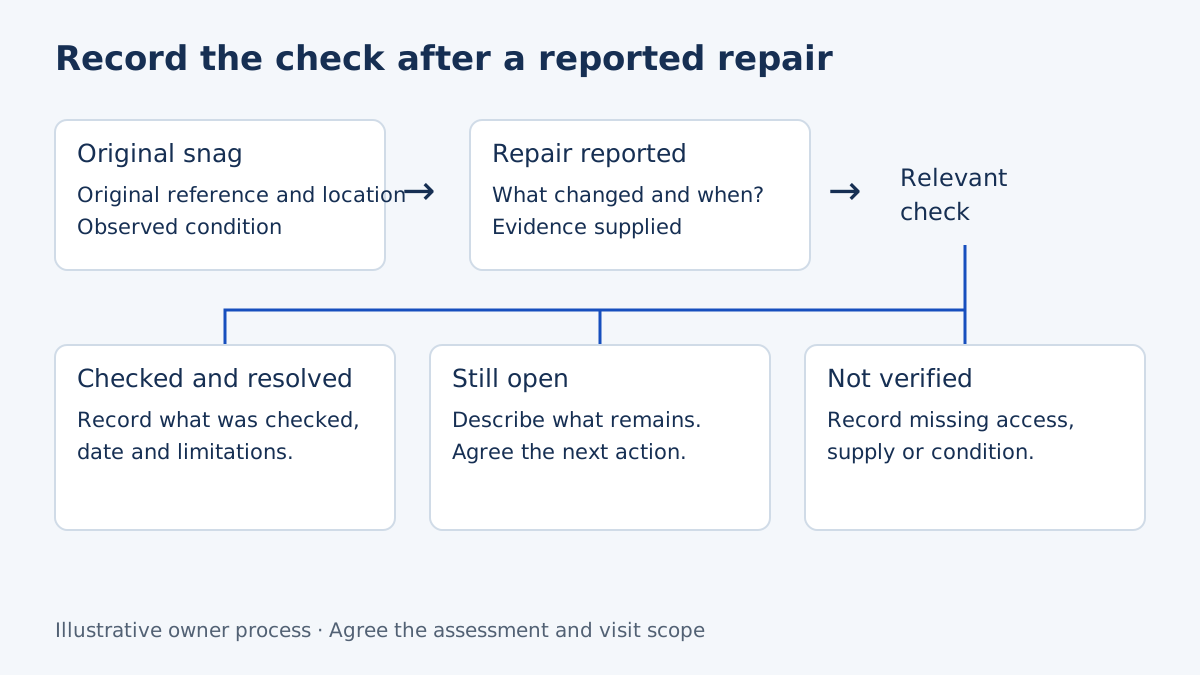
After the builder reports that snags, or issues listed in the inspection report, are fixed, check the result against each original finding. Record whether the agreed check found the issue resolved, still open or not verified. "Not verified" means the inspector could not confirm the result. Keep repair photographs and completion messages, but ask what check would show whether the original problem has stopped.

What should be agreed before a follow-up visit?
Before booking, agree which original items the inspector will revisit and what they will check. Confirm the access and utilities they need, the record you will receive, availability and charges. Do not assume that a re-inspection is included in the original fee or that it repeats a whole-flat inspection.
InterNACHI's scope guidance describes scope as something the client and inspector can agree before the visit. Use this guidance to discuss the proposed checks before booking. It does not define Ezeetask's follow-up service.
For a Delhi NCR apartment, the builder or society may need to arrange entry, keys and access to particular areas. Send the marked original report in advance. Ask for a response beside each report item showing what changed and where. A message saying "all snags fixed" leaves the inspector without those details.
What evidence makes a repair ready to check?
Ask for a short repair response against each original reference. It can identify the component addressed, the work date, the contractor's explanation and supporting photographs or documents. Where a specialist carried out work, retain their record rather than reducing it to a screenshot of a completion message.
This does not require an owner to approve a technical repair method. If the original report recommended further evaluation, ask whether that evaluation took place and what it concluded. Ask how the work addresses the original concern if the repair only covers the visible symptom.
| Original concern | Useful repair information | What remains to be established |
|---|---|---|
| Door does not latch | Hardware adjusted or replaced; location identified | Relevant operation checked without forcing it |
| Drip below a sink | Connection addressed; work date recorded | Relevant use condition assessed safely |
| Visible chipped tile | Exact tile replaced; completion image | Finish and nearby disturbed area reviewed |
| Damp mark on wall | Investigation and remedial action described | Whether evidence supports resolution, with remaining limits |
| Electrical concern | Qualified contractor’s work record | Appropriate professional verification within agreed scope |
Use these examples to ask for repair records. Leave testing to appropriate professionals, and agree which outcomes they can assess during the visit.
Is a photograph enough to close a snag?
Sometimes a photograph can document a visible change; it cannot answer every functional question. A clear image may show that trim has been replaced. It cannot show whether a drain performs adequately or a window now operates as intended.
Record how the inspector reviewed the item. "Photo reviewed" and "checked on site" describe different evidence. If the inspector cannot assess a rain-linked concern under the conditions it occurs in, record that limit. Do not simulate rain, flood a wet area or apply pressure without an appropriately planned professional procedure and permission.
InterNACHI's limitations guidance explains that inspection findings relate to visible conditions at a particular time. A dry-looking surface alone cannot guarantee future performance.
How should the follow-up record be written?
Keep the original reference unchanged and add a dated follow-up entry. You can then compare the checks and still see the original finding.
In each entry, describe the reported repair and what the inspector checked. Add the result, any limits and the next action. Write "door latched during the visit" if that is what the inspector observed. That check cannot establish that all door defects are permanently fixed.
For an item that remains unresolved, describe what still occurs. For an item that could not be checked, identify the missing condition: no water supply, inaccessible location, fresh work that the contractor says is not ready for checking, or an absent specialist record. Ask who will arrange the next step and when readiness will be confirmed.
The home inspection report page provides context for how findings are organised. InterNACHI's report guidance also recommends explaining observations and next actions. Use the sample and guidance alongside the list of checks you agreed for this visit.
What if the repairs introduce another problem?
Record the new observation separately and link it to the relevant work area. For example, a replacement tile may be accompanied by a newly visible chip nearby. Describe the location and timing without assuming who caused it.
Keep the original finding and give the new one its own row. One item may be resolved while another remains open. The inspector might also be seeing an issue that was concealed at the first visit. Keep the first report and photographs to help everyone discuss what changed.
If the new concern falls outside the booked checks, ask what additional assessment is appropriate. A limited re-inspection covers the agreed checks. If you need the inspector to assess new work elsewhere in the flat, discuss whether to arrange another visit with its own agreed scope.
How can you avoid a wasted return visit?
Before confirming the date, run through this short readiness list with the site contact:
- The specific repair rows are identified as ready for review.
- Required access, keys and utilities are available.
- Work areas are visible and reachable without unsafe access.
- Relevant repair records have been shared.
- The contractor has confirmed any required curing, meaning time for materials to set, and whether the work is ready to check.
- The checking scope, output and fee have been agreed.
Use the PDI preparation guide for access planning. When discussing pre-delivery inspection, share your existing report and confirm which follow-up checks are available.
Questions about snag closure
Does "closed" mean the entire flat is defect-free?
No. Mark a named finding closed only against the evidence from the agreed check. It does not certify concealed work, structural safety or overall code compliance.
Should all repairs be completed before the visit?
Agree the visit's purpose. You may need a check during the work, before the contractor covers an area. For a completion check, the selected items need to be ready. Availability and charges for additional visits require confirmation.
Can I delete rows after they are resolved?
Keep them with the outcome and date. A retained record is more useful than a shrinking list when a concern returns or the next contractor needs to understand what was changed.
Related reading
Sources and further reading
- InterNACHI: Home inspection reports: clear observations and recommendations.
- InterNACHI: Limitations of a home inspection: time, visibility and specialist boundaries.
- InterNACHI: Inspection standards overview: scope agreement; overseas professional guidance, not Ezeetask service terms.