home inspection · 7 min read
How to prioritise a flat snag report
Sort your flat snag report by safety, active damage, function and finish. Track responsibility, repair evidence and unchecked items before interiors begin.
A snag report lists conditions found during an inspection, including defects that need attention. Read possible safety concerns and active damage first, followed by problems with everyday use and appearance. For each item, record who will coordinate the response, what happens next and whether anyone has checked the result. Ten finish observations may need less urgent attention than one unresolved leak; report length alone does not tell you how serious the problems are.

Which findings should you read first?
Read the summary and the limits of the inspection before working through the findings. Ask the inspector to explain any wording that leaves you unsure what to do. If the report says "attention required," ask what the inspector saw, where they saw it and what they recommend.
InterNACHI's guidance on what matters in an inspection distinguishes hazards and consequential problems from minor imperfections. You can use that distinction to organise your list. It does not provide a universal scoring system for Indian flats. The categories below help you plan the next steps; the inspecting professional should assess the condition.
| Practical category | Example of a reported concern | Useful next action |
|---|---|---|
| Possible safety concern | Accessible electrical parts reported as unsafe | Keep people away and obtain qualified assessment promptly |
| Active or recurring damage | Water appearing below a connection during use | Arrange investigation and protection of affected finishes |
| Function affected | A door does not latch or a drain performs poorly | Agree the correction and the operation to be checked afterwards |
| Finish or appearance | A visible paint mark or chipped trim | Record the exact location and agreed finish work |
| Not checked | A locked room or unavailable supply | Arrange access; do not treat it as satisfactory |
Do not open an electrical board, touch suspected live parts or reproduce a dangerous condition for a better photograph. Where the report raises a structural concern, seek the appropriate engineering assessment; a snag report does not certify structural safety.
Why is the total number of observations misleading?
An observation can record a satisfactory condition, a limitation, a maintenance recommendation or a defect. Several photographs may describe one underlying concern. One summary line may also cover several locations where you need to track repairs separately.
Ask what the report total counts. Do not convert pages, photographs or observations into a defect total. For an illustration of how findings can be presented, see the home inspection report page, then compare the terminology with your own report.
Make a working list of findings that need a response. Keep the original reference beside each row. If three locations share a suspected cause, link the rows but retain their separate locations: a repair at one point does not demonstrate that all three are resolved.
How do priority and status work together?
Use a priority column to show what needs attention first and a status column to show what you know about the repair. You may have a report of repair work on an urgent item without anyone having checked it. For a minor finish item, you may already have a checked result.
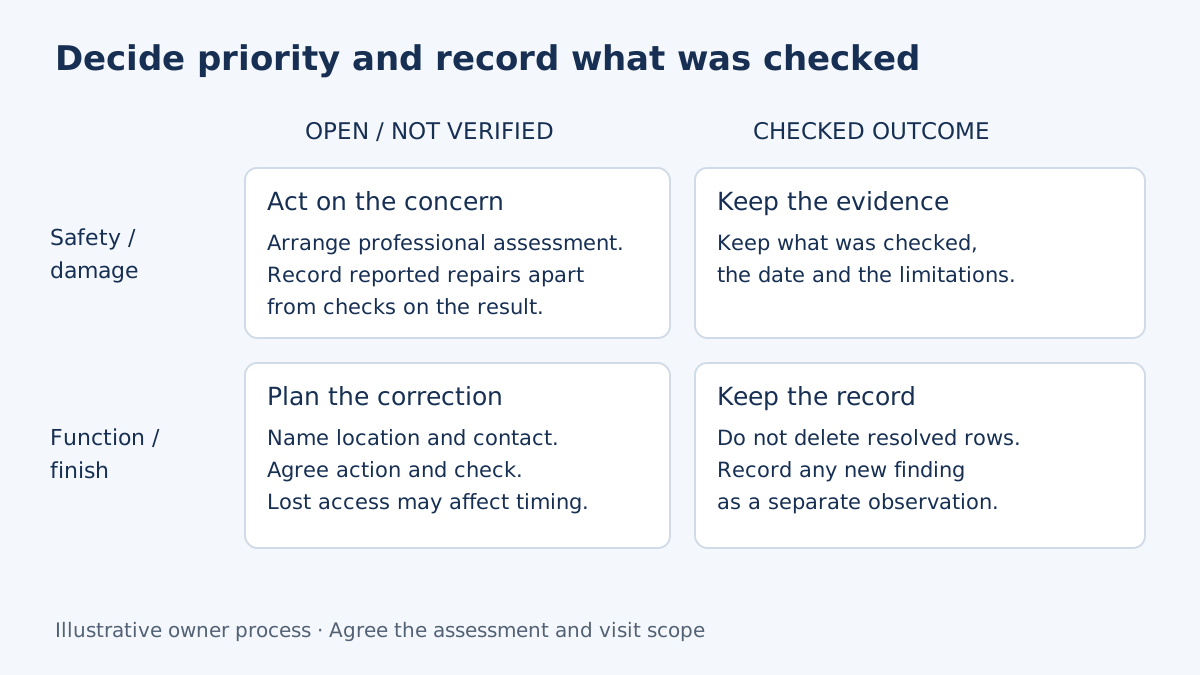
Track each item as open, repair reported or outcome checked. Use "not verified," meaning the inspector could not confirm the result, if they lacked access, utilities or suitable conditions. Record what prevented the check so you know what to arrange next.
For example, a report says a window is difficult to close, and a contractor sends a picture of new hardware. You have evidence of a reported change, but still need someone to assess whether the window closes as it should. Keep the original finding on the list until then. This example illustrates the process; it is not an Ezeetask case history.
What should each tracking row contain?
Use a spreadsheet or a simple shared document. A workable row contains:
- Original report reference and room or location.
- Plain description of the observed condition.
- Priority explained in words, including any professional advice.
- Person coordinating the response, with their agreement still to be confirmed.
- Proposed action and agreed target date, if available.
- Repair evidence received and its date.
- Verification result, limitations and next action.
The "owner" of a row is the person coordinating the response. Naming them does not establish legal liability. Avoid assigning blame from a photograph or from the location of a stain. Ask the builder, society and relevant contractor who will investigate each item; record their answer separately from what the inspector observed.
InterNACHI's report guidance supports descriptions that explain the concern and recommend a next step. The tracking format above is a practical way to organise that information, not a prescribed industry form.
How should Delhi NCR apartment owners sequence the work?
Plan work around access and any repairs that must happen first, as well as priority. If a plumbing concern needs access behind a planned cabinet, resolve the access question before the cabinet is fitted. If a window concern needs exterior access, coordinate through the building team rather than leaning out or arranging an improvised test.
Share one current list before a joint site visit. Ask which items are ready for assessment and whether water, electricity and relevant rooms will be available. Confirm whether the appointment includes checking the repairs or carrying them out.
Keep a separate list of decisions you have accepted, postponed or referred. Record the reason and a date to revisit the decision. You can then return to finish work after dealing with urgent concerns.
For broader room-by-room coverage, use the flat possession checklist. For help documenting findings before handover, discuss the actual flat, access and agreed scope through pre-delivery inspection.
Questions owners ask about snag priorities
Does the builder have to accept every observation?
The inspector records findings in the report. The report alone cannot determine contractual responsibility or compel the builder to agree. Keep the technical discussion tied to locations and evidence. Questions about obligations need the relevant agreement and appropriate advice.
Can a low-priority item wait indefinitely?
No category replaces judgement. A small mark associated with recurring moisture needs a different response from a dry paint blemish. Ask what would change the priority and record a review point.
Is an unchecked area the same as a passed area?
No. The ASHI reporting standard distinguishes inspected findings from items not inspected and the reasons. It is a US professional reference, not Indian law or Ezeetask's contractual scope. Record what the inspector could not check and why.
Related reading
- Re-inspection after builder repairs: what to verify
- Outstation flat owners: making an inspection useful
Sources and further reading
- InterNACHI: What really matters in a home inspection: prioritisation principles; overseas transaction commentary does not establish local obligations.
- InterNACHI: Home inspection reports: descriptions, recommendations and limitations.
- ASHI: Standard of practice: reporting distinctions; its defined US inspection scope is not a Delhi NCR apartment package.