seepage · 7 min read
Pressure tests for concealed pipes: what they prove
A concealed pipe pressure test checks a defined section under recorded conditions. Learn what a drop, stable reading or incomplete test can mean.
In a concealed pipe pressure test, a professional checks a specific pipe section under controlled conditions and records the readings. A pressure drop they cannot explain may warrant further investigation, but it does not locate the leak. A stable reading tells you only about the section and conditions tested. Other sources of dampness in the home may remain unchecked.
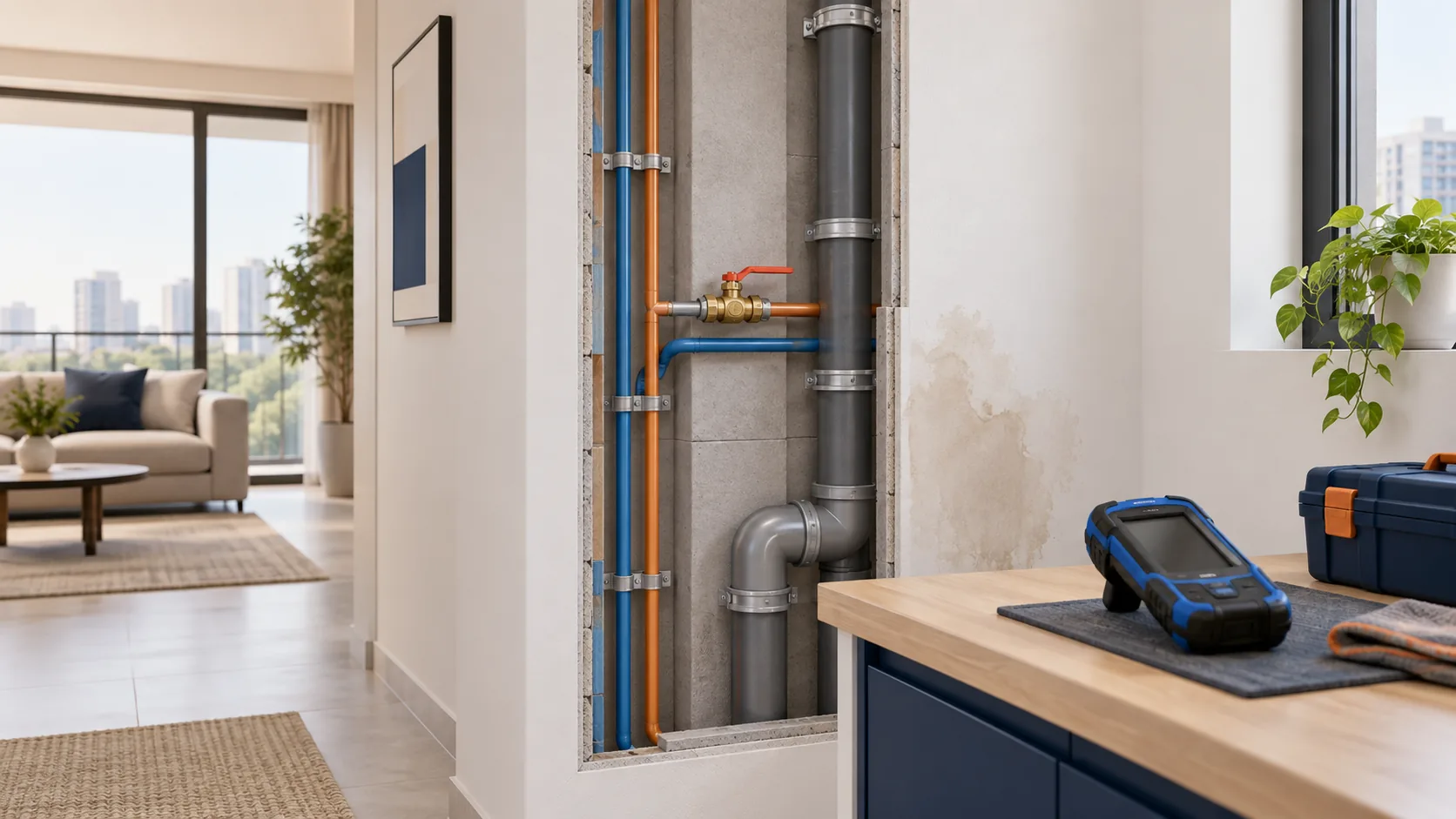
Use this guide to understand a professional's test and report. Do not attempt the test yourself. The professional must choose a suitable test medium, meaning what they use to apply pressure, as well as the pressure, duration and precautions for the pipe system and connected equipment.
Which pipe section is being tested?
Ask which pipe section the professional will test, where it starts and ends, and which branches or appliances they will leave out. A label such as "bathroom checked" does not explain that scope. Hot and cold supplies, shared vertical pipes called risers, and fittings may fall outside the section being tested.
Ask for that boundary in plain language or on a simple sketch. The report should name any branch the professional tested on its own. If they could not isolate a section, meaning separate it from the rest of the supply, they should record it as unverified.
Uponor's PEX installation guide gives a specific example: its commercial test guidance requires the operator to isolate components not rated for the test and other thermoplastic piping (a type of plastic pipe). This is manufacturer guidance for a particular system, not a pressure-test recipe for every Delhi NCR home.
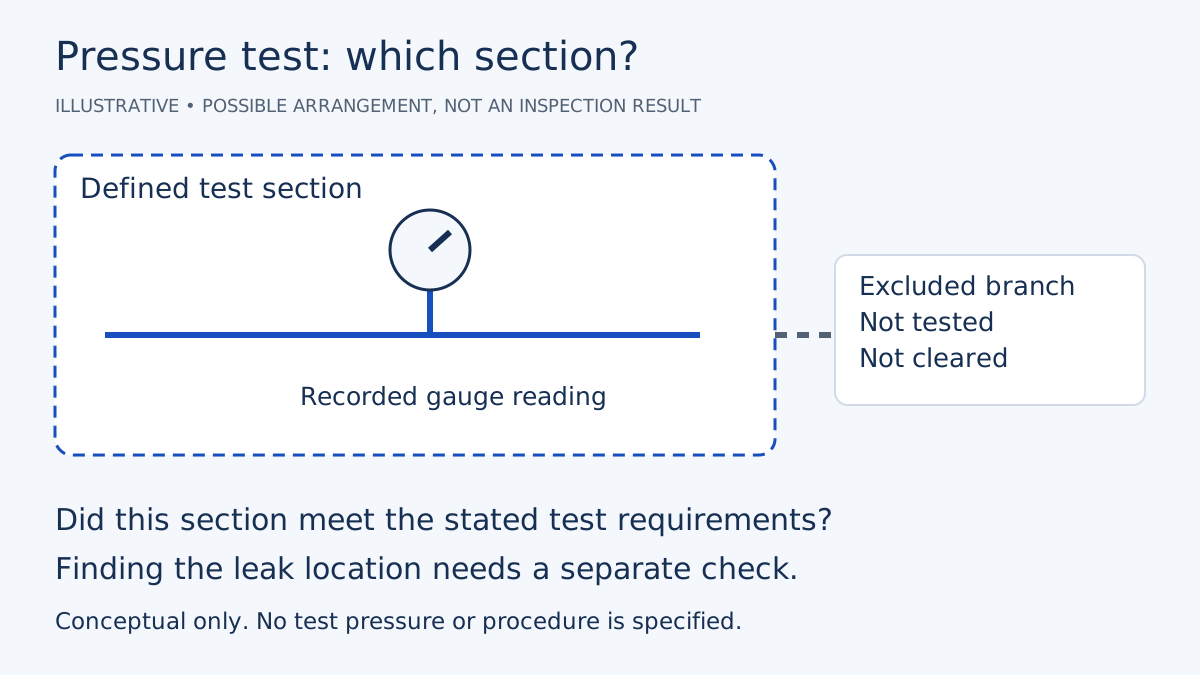
Does a falling gauge reading prove a concealed pipe is leaking?
The professional needs to interpret the drop before attributing it to a hidden pipe defect. They must check the test setup and connected components against the acceptance criteria, meaning the conditions for a satisfactory result. Ask whether a test connection or incomplete isolation could explain the drop instead of a fault in the hidden pipe.
Pressure can also change for reasons other than water escaping through a defect. Uponor's guide discusses pipe conditioning in its commercial PEX procedure and notes that ambient temperature changes can produce small fluctuations. The practical lesson is to document conditions and follow the correct procedure, not to dismiss any fall as temperature-related.
Ask the professional to explain how they reached the conclusion. One gauge photograph cannot show both the starting value and elapsed time. Even with two photographs, you need to know which connected pipe section, or circuit, they tested.
Why is there no single correct pressure for every home?
Different pipe products and installations have different requirements. The professional must also account for equipment connected to the section they are checking. A pressure copied from an online demonstration may be inappropriate for the actual installation.
Uponor's technical FAQ lists product-specific temperature and pressure ratings and separate testing guidance. Those values belong to the named product and context. They are not interchangeable with an unknown mixed-material domestic system, so this guide gives no universal pressure or duration for holding it.
Ask the professional which manufacturer's instructions or applicable procedure governs the test. An answer such as "this is what we always use" leaves the system and its limits unexplained. Existing pipe records, repair invoices and accessible markings may help; do not remove finishes to search for them yourself.
What does a stable pressure reading exclude?
You can interpret the result only within the section, conditions and duration tested, and the sensitivity of the setup. The professional may conclude that the selected circuit met the stated criterion during the test. They cannot use it to certify the entire property as leak-free or guarantee future performance.
A supply-pipe test cannot check every route water might take. A drain may leak while discharging, rain may enter at an external joint or detail, or water may pass through the layers beneath bathroom tiles. If the dampness continues, ask the professional to investigate the remaining possible sources before you repaint.
| Reported outcome | Reasonable interpretation | What still needs stating |
|---|---|---|
| Stable under the stated criterion | No relevant loss established in that tested section during the test | Boundary, duration, conditions and exclusions |
| Unexplained pressure loss | Further investigation of the circuit or setup is warranted | What was checked before attributing it to concealed pipework |
| Could not isolate the section | The intended test was not completed | Access or plumbing work needed to complete it |
| Only part of the supply tested | Evidence applies to that part | Other sections still unverified |
| Dampness continues after a satisfactory result | The symptom remains unresolved | Which other sources or conditions need assessment |
Is pressure testing part of every home inspection?
Do not assume so. The InterNACHI Standards of Practice describe a visual, non-invasive inspection of accessible areas. That definition does not, by itself, promise a specialist concealed-pipe pressure test. These are an inspection body's scope definitions, not Indian law or Ezeetask's package terms.
A general inspection of the home's condition and an agreed specialist investigation can cover different checks. Ask whether pressure testing is proposed for your particular concern, what access it needs, and how it will be documented. A service name alone does not settle which tests are included.
In Delhi NCR apartments, society permission and access to the relevant plumbing controls can affect what is achievable on the day. Confirm arrangements with maintenance and the inspector before the visit. Residents should not operate common valves or attempt to isolate a shared riser themselves.
What should a useful pressure-test record contain?
Ask for a record you can connect to the repair decision:
- The named circuit or section and its isolation boundary.
- Known pipe material and any uncertainty about the installation.
- The procedure or acceptance criterion used.
- Initial and final observations, elapsed time and relevant conditions.
- Accessible leakage observed, setup issues and sections not tested.
- The conclusion, its limits and the next step if the source remains unclear.
These are questions for the professional record, not instructions for running the test. Keep the original record with later repair and recheck notes so another contractor can see what the professional established.
For the wider evidence format, see the seepage inspection report guide. If thermal images accompany the gauge readings, thermal imaging limitations explains why those images also require interpretation.
What should happen before you approve repairs?
Ask whether the suspected source has been located or only narrowed to a circuit. Those outcomes call for different next steps. Discuss water leakage detection when the concealed section needs further investigation, and the broader seepage inspection scope when several water pathways remain plausible.
For bathroom leakage, share when the symptom appears and which fixtures were in use. Agree how much to open and who will restore the surface as a separate part of the work; a pressure result does not by itself define how much tile or plaster needs removal.
Frequently asked questions
Can a passed test settle a recurring ceiling stain?
Only if the overall investigation explains the stain. A satisfactory result on one supply section leaves unrelated pathways and untested sections outside its conclusion.
Can I compare readings from two different visits?
Only with context. Ask whether the same circuit, procedure and relevant conditions were used. Bare gauge numbers may not be comparable.
Should repairs be rechecked?
Ask the repair professional what verification is appropriate to the work performed and how it will be recorded. A repair photograph and a documented check answer different questions.
Related reading
Sources and further reading
- Uponor: PEX Piping Systems Installation Guide, printed pages 88–90 on pressure testing, isolation and temperature effects; product-specific guidance.
- Uponor: Technical FAQs, product ratings and testing requirements; not universal domestic thresholds.
- InterNACHI: Home Inspection Standards of Practice, visual inspection boundaries and plumbing exclusions; not an Indian statutory standard.