seepage · 7 min read
Balcony leakage into the flat below: next steps
Balcony leakage downstairs needs a source check. Learn what drains, thresholds and junctions can reveal, and how to arrange access before repair work.
If a balcony leaks into the flat below, arrange for an inspector to check the balcony, its drain and adjoining joints, as well as the affected ceiling downstairs. A stain under a balcony alone cannot prove that the whole waterproof layer has failed. Record when the stain appears and arrange access before choosing a drain repair, a repair at a joint or wider waterproofing work.
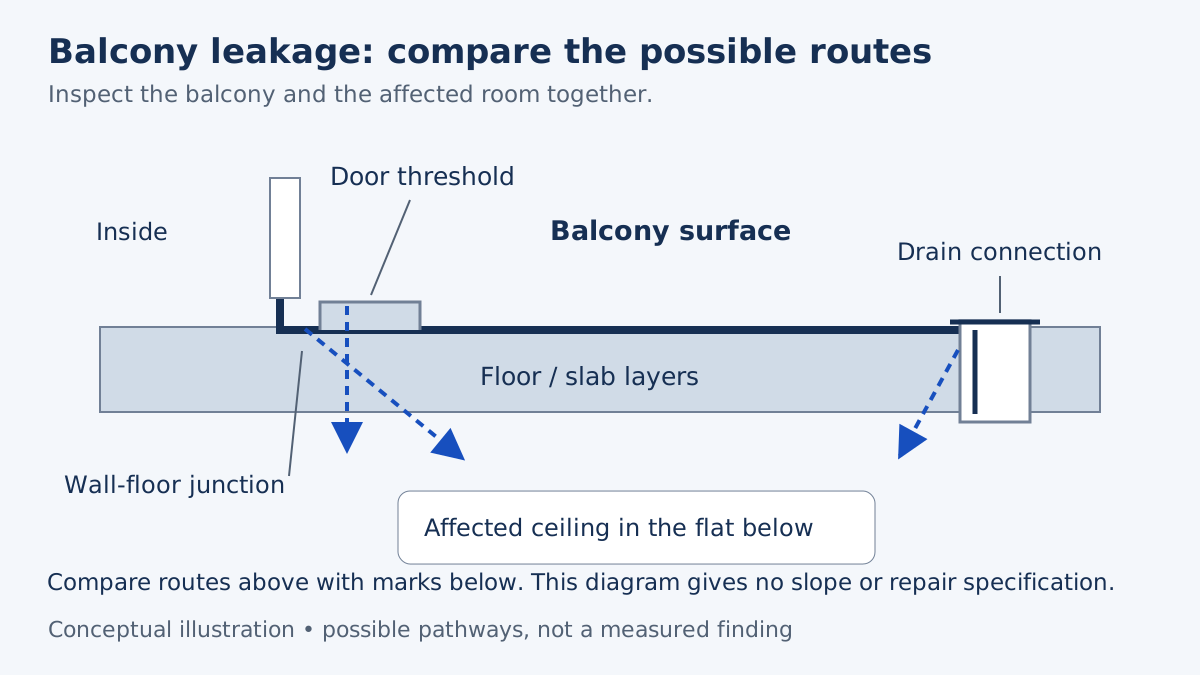
Why can a balcony leak into the flat below?
Water can reach the ceiling through several routes: around a drain connection, through a gap where the floor meets the wall, around the doorway, or through a defect in the floor's layers. A nearby service pipe could also be leaking. Ask the inspector to compare these possibilities before treating the problem as a terrace waterproofing failure.
A balcony helps protect the building from weather. Its surface needs to drain water, while the edges and joints around openings need to keep water outside. WBDG's residential enclosure guidance explains the importance of drainage and protected door and window junctions. The examples concern North American construction. An inspector can consider the principles, but they do not specify how to repair a balcony in a Delhi NCR apartment.
The ceiling mark may be some distance from where water enters. Building Science Corporation explains that water can move sideways through porous materials and along building assemblies. An inspector may start above the stain, but still needs evidence to confirm the source.
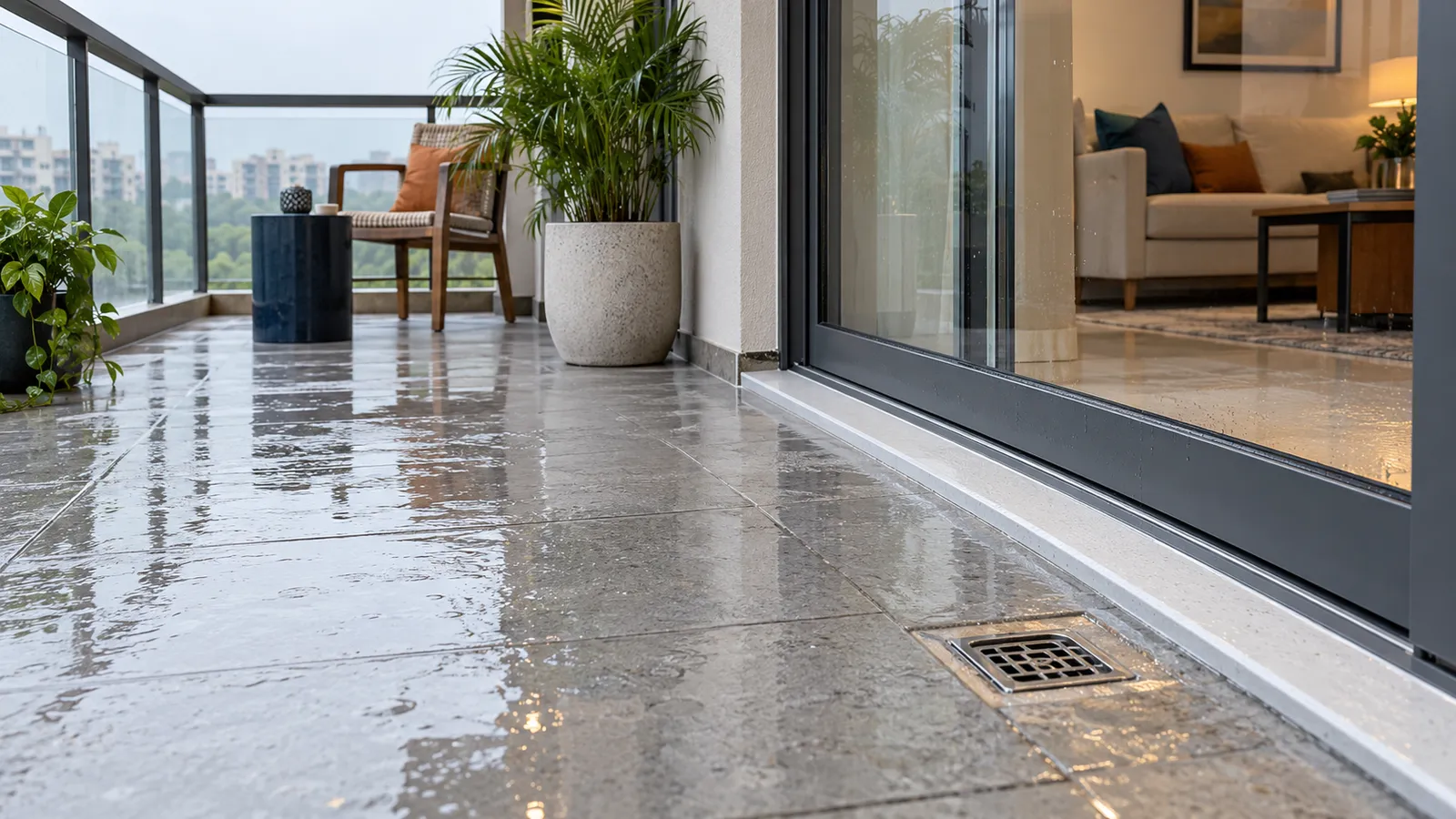
What does standing water tell you?
If you see standing water, ask the inspector to check drainage. The puddle may be related to the leak, but it cannot identify where water enters the building. The inspector needs evidence to connect the two.
These observations can help you describe the concern:
| Observation | Useful question | What it does not establish |
|---|---|---|
| Water remains near the drain | Is the outlet obstructed or is the local surface holding water? | That the waterproof layer across the whole balcony has failed |
| Damp grows after ordinary balcony washing | Which route is wetted during normal use? | That the same route explains every rain-related stain |
| Water gathers beside the door | How do the threshold and floor levels manage water? | The correct height or repair detail for this property |
| Downstairs stain appears after rain | Which exposed surfaces and junctions became wet? | That the balcony floor is the only possible source |
| Damp continues during a dry spell | Are services leaking, or are materials still drying? | That rainwater has been ruled out |
Observe the balcony during normal use and rain; do not pour extra water over suspect areas for your record. Photograph the whole balcony as well as the puddle so the inspector can see its position relative to the drain and door.
Who needs to provide access?
Try to arrange one agreed appointment covering the balcony above and the affected room below. In an apartment building, ask the society or facilities team about access to the relevant drain or service shaft. The inspector should know beforehand if any part is unavailable.
Tell each person which areas the inspector needs to see and who will open them. Note any furniture that prevents access. Obtain the neighbour's agreement before entering or photographing their home. Keep unrelated belongings and personal details out of photographs shared with contractors.
If the balcony belongs to another flat, describe what you observed: "The patch became darker after Tuesday's rain." Avoid saying "Your waterproofing is defective" before an inspector has checked the source. If the inspector cannot access the upper balcony, ask them to record that limit and leave the cause unconfirmed.
What can you record safely before the visit?
Keep a short, dated record so the inspector can compare conditions without asking anyone to recreate a leak.
- Photograph the ceiling from a repeatable position, including a corner or doorway for orientation.
- Record the date of rain or normal balcony cleaning and when you first noticed the stain.
- Note whether the balcony is open, covered or partly enclosed.
- List recent changes: retiling, a new door, drain work or railing work.
- Photograph visible standing water from a safe position inside the balcony.
- Save earlier repair scopes and photographs, if available.
Keep away from loose ceiling finishes, and ask building maintenance for prompt help if water is near an electrical fitting. Do not open fittings, climb outside the railing or remove drain parts yourself. The broader post-rain seepage checklist can help record other affected areas without narrowing the investigation too early.
Should you ask for a flood test?
Ask what question a proposed test would answer and how the professional will protect both flats. Do not block a balcony drain and fill the floor yourself. Existing damage, threshold levels, drainage arrangements and access downstairs all affect whether a controlled test is appropriate.
A manufacturer's test procedure belongs to its specified system. For example, Schluter's water-test guidance concerns its shower assembly and includes curing conditions. A professional must choose a test method for the actual balcony and agree permissions, observation points and stopping conditions before testing.
What should the repair proposal explain?
Ask the contractor to explain in writing how the proposed work addresses the finding. Request the exact detail they plan to repair and a list of areas they could not verify. Confirm what preparation and access the quote covers, and how they will restore any areas they open. Agree how they will check the repair before refinishing the downstairs ceiling.
The repair plan needs to allow drainage and drying as well as prevent water entry; WBDG's moisture-management guidance treats them as parts of moisture control. Repainting downstairs may restore the finish. If water still enters from above, the contractor needs to address that route before you commit to decoration. Agree the repair and follow-up sequence first.
Common questions
Does the whole balcony need to be broken up?
That cannot be decided from a stain alone. A local defect may need a different repair from a problem affecting several floor layers. Ask what evidence supports the proposed extent of opening or replacement.
Can a dry inspection rule out a leak?
An inspector can record the visible condition on a dry day and narrow the possibilities. To check a leak that appears only after rain, they may need more observations or an agreed professional test.
What is the next step for a Delhi NCR flat?
For recurring ceiling leakage, prepare the timing record and confirm access to both levels. Discuss those details when arranging a leakage and seepage assessment, so the inspector can check possible routes through the balcony as well as the stain below.
Related reading
Sources and further reading
- WBDG: Residential Building Enclosure: drainage and opening junction principles; construction examples need local interpretation.
- WBDG: Moisture Management: entry control and drying; not a prescribed balcony repair.
- Building Science Corporation: Investigating and Diagnosing Moisture Problems: water movement and diagnostic reasoning.
- Schluter: Shower-system water testing: an example of system-specific testing, not instructions for this balcony.